Showing posts with label Stephen King. Show all posts

Novella Review: "Gwendy's Button Box" by Stephen King and Richard Chizmar

Click image to see
price on Amazon
Stephen King has teamed up with another writer once again; this time to bring us a novella-length tale featuring King's favorite antagonist. In Gwendy's Button Box, The Man in Black, Walter o'Dim or whatever moniker you favor has a dark task for a little girl whose insecurities make her the perfect target for an evil wizard. Richard Chizmar, editor, author and founder of Cemetery Dance, is King's wingman for this exploit into the deranged hijinks Flagg gets up to when he's not busy tormenting Roland.

I'm going to spoil a few little things ahead. No biggies.

Gwendy's Button Box is about a gal named Gwendy who is putting forth a Herculean effort to lose weight by running up heart-attack inducing steps in her hometown when she meets The Man in Black. He's struck by something about her and decides to task her with safeguarding a strange box covered in buttons. Gwendy takes the challenge, little knowing that she's made a deal with the proverbial devil.

Like any good mysterious magical object, Gwendy's button box offers rewards and consequences. What's different about Gwendy's button box is that she can seemingly avoid the consequences if she is able to resist an almost supernatural urge to push the box's buttons. Soon, the novella becomes a tug of war between a growing young woman and the powers of the peculiar box. At first lacking in immediate threats to get the blood pumping, it isn't long before the sick imaginations of two accomplished writers are put to work.

Good co-writing makes it difficult, if not impossible, for the reader to tell who is at the wheel in any given section of the book. (I'm currently challenging myself to see where Owen King has taken the lead in Sleeping Beauties. I'm failing.) Whether the writers have done a great job of editing each other, have a solid sense of the work's voice or both, they manage to keep disbelief suspended with a fluid narrative. Chizmar and King do that wonderfully for Gwendy's Button Box. I'm hoping they decide to take on something a bit longer in the future.

Shelly Barclay

Book Review: Stephen King's "End of Watch"

Click image to
see price on Amazon
Decades into a prolific and successful career, Stephen King is still churning out trilogies. His latest follows the post-retirement years of Detective Bill Hodges. I just finished up End of Watch–the final novel of the trio. It appears the adventures of this intrepid ex-cop and his arch-nemesis "The Mercedes Killer" are wrapped up with a neat bow in this one. While not my favorite of the bunch (I'd be hard pressed to choose between Mr. Mercedes and Finders Keepers), End of Watch is a fantastic finish that brings in a lot of the mindeffery for which we know and love the King.

*Some spoilers

End of Watch finds Bill (real name Kermit) and his partner-in-crime-fighting Holly Gibney dealing with Bill's grim diagnosis of pancreatic cancer and the reappearance of Brady Hartsfield in their lives. Hartsfield, a serial killer who plowed down dozens of people in the first book of the trilogy, is a near-vegetable at the local hospital. How is it that Bill suspects the brain trauma patient in a recent rash of suicides?

Before End of Watch, King had largely refrained from the more fantastic aspects of his imagination with this trilogy. We've been given straight-up everyday evil against a flawed hero in two relatively normal, though outstandingly written, detective novels. King opened up the floodgates for the last hurrah, bringing back an old favorite of his–telekinesis.

Because of the supernatural twist hinted at in Finders Keepers and delivered in End of Watch, Hodges finds himself in the most challenging case of his busy retirement. Some might call it an easy way to bring back a crippled antagonist, but I found Hartsfield too intriguing, too disgusting to be done away with in a single book. It was fitting to have him back too see how he would fare against an again weakened Hodges in a second round.

I enjoyed the book on a few lazy days swinging in my hammock this summer. As usual, I was thoroughly entertained by Mr. King and bummed out when the book inevitably ended. I'll wrap this up by noting how much I loved King's treatment of the ever-anxious Holly Gibney. I have an anxiety disorder myself and enjoyed having a hero more on my level. I'm also very happy that King touched on themes of suicide and then included an encouraging note to those of us who struggle with those issues to seek help and be patient enough for the good times to come back. I was truly moved.

Shelly Barclay

Book Review: "11/22/63" by Stephen King

Click image to
see price on Amazon
The cover of 11/22/63 is enough to draw in a huge readership. You have the name of the literal and figurative king of horror. History buffs will recognize the eponymous date that U.S. President John Fitzgerald Kennedy was shot and killed by an assassin, presumably Lee Harvey Oswald. I don't know about you, but I was easily sucked in.
On first glance, I was curious if this was another of Stephen King's forays into non-fiction. There is no denying that the man is fixated on an earlier, simpler America. Perhaps it was time for him to write facts about the times that inspired him. Was 11//22/6 something else like Richard Preston's The Hot Zone–a non-fiction book told like a novel? Was Stephen King combining fact and fiction? It turned out to be the latter.

King has obviously waded through a mountain of research to complete 11/22/63 and, as far as this history buff can tell, he never grievously deviates from the facts as we know them. In fact, he digs right into the gritty little details. One cannot help noticing that King seems to enjoy these details–the gritty story of the bad guy. He always has.

I will try to give away practically nothing about this book because I want you to read it. So, I will have to be cryptic. Yes, this book delves deeply into the assassination of President Kennedy, but more the events leading up to it. The central characters in the book are not historical figures. They are the usual fictitious small town, likeable, flawed characters you find in King's novels. They are in quite an unusual situation. The past and the present intertwine with love, loss and a struggle against the supernatural. There is also a brilliant nod to It in 11/22/63. If you are a fan, you cannot miss it.

When I first started reading, I thought that I was going to spend the whole time wanting to skip ahead to the moment King provoked us with. He certainly did not need this topic to sell books, so my only explanation is that he knew we would be itching to find out what happens in Dealey Plaza in Stephen King's imagination. However, to my surprise, I did not skip forward once. I wanted more to know how he got there than what happened once he did. I knew King was not going to do something crazy like change history . . . or was he? You will have to find out.

Update: The book was made into a very good miniseries. Check that out too, if you can.

Book Review: "Finders Keepers" by Stephen King

Finders Keepers
Cover art used under fair use
Copyright held by publisher or artist
"Finders Keepers" is the sequel to "Mr. Mercedes" and the second in what will become a trilogy in the summer of 2016. Unlike "Mr. Mercedes," "Finders Keepers" focuses on an unfortunately fortunate kid and an author killer who has just been let out of prison. However, Bill Hodges and his friends return as a major part of the novel, as does the Mercedes Killer himself, tying it all together in a neat little package.

Mild spoilers ahead.

It's no secret that I like Stephen King's style a lot. However, as I've said before, I don't like every single one of his novels, but I like this one. Hodges comes back in trimmer shape after suffering a heart attack at the end of the last novel. He and his neurotic partner started up a private detective agency called Finders Keepers. They are brought into a bigger case than they imagine when a friend's younger sister shows up at their office.

Central to the story is Peter Saubers, a boy who unwittingly made a discovery that may have saved his family from abject poverty and the dissolution of his parents' marriage. However, this find has some serious history that is about to come back to haunt young Peter.

The novel follows the original owner of Peter's discovery and Peter as one tries to find what he buried decades earlier and the other tries to help his family stay above water. It's easy to care about the characters, with the exception of the very bad man. The plot is well paced, and there was a serious teaser for the next novel that has me very excited. I venture to guess that will be the best and most Stephen King-esque of the bunch.


Shelly Barclay

Book Review: "Mr. Mercedes" by Stephen King

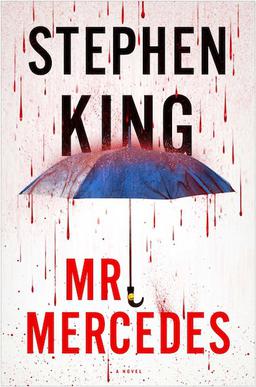
Mr. Mercedes
Cover art for "Mr. Mercedes"
(Copyright reserved
by artist or publisher)
So, I just finished reading Stephen King's award-winning detective novel "Mr. Mercedes." (Well, not just finished. I read the sequel before I could stop reading long enough to write this review.) To put it right out there, I completely and utterly enjoyed it. With the exception of one device I found a little annoying, it was excellent. The pacing was great, the characters rich and the bad guy excruciatingly creepy.

There be spoilers ahead.

"Mr. Mercedes" opens on an all too real setting that addresses the recession and shows the desperation of working class Americans in stark relief. You get a glimpse at an average guy waiting in line at a job fair insanely early in the morning hoping to land a job that will keep him above water. You warm to him as he meets a young mother who had to bring her baby out on this cold night so she could continue to provide for her child. Your mind will start to weave a tapestry that centers on these characters, but don't get used to them. Just a few pages in, I was kicked in the teeth by Stephen King. I can't recall another opener from him that is anything like it.

The meat of "Mr. Mercedes" comes soon after the open. You meet retired police detective Kermit (Bill) Hodges, who is deeply depressed and still brooding over the biggest case of his life–The Mercedes Killer. He didn't catch the guy, but the guy soon catches up with him. In a game of cat and mouse that never drags, the two dance around each other while one finds new purpose in his life and the other plans further atrocities.

Bill Hodges is likable, as are a few of Bill's friends, but the most memorable character is Mr. Mercedes himself. King succeeded in making him truly loathesome. I can't think of a single redeeming quality. Jerome, the teen that mows Hodges' lawn, is quirky and intelligent. I liked this character as well, but King had him lapse into Detta Walker-like lingo as a joke too many times for my taste. I found myself thinking that this would annoy me if someone I knew did it, so I got a little exasperated whenever Jerome did it. It wasn't annoying when Detta did it because it was how she talked. Really, this is my only criticism and it's not a biggie.

Stephen King has had a few books that didn't resonate with me. "Mr. Mercedes" is not one of them. King is at his best, like he is most of the time, throughout the novel. I strongly recommend it, even to people who avoid King because they don't like horror. This is not horror, though it has horrific moments. This is a detective thriller that covers an act of terror from every angle. And it's good.


Shelly Barclay

Books I Have Read More Than Once

Harper Lee
Harper Lee
Some books are just so good that you have to read them again. Sometimes, you have to read them repeatedly. It does not matter how intellectual or significant the book is; there is just something about it that keeps drawing you back into the story. For me, this has been true for a great many books. However, there are a rare few that I have found myself reading closer to five times than one.

The Harry Potter series by J.K. Rowling


The Harry Potter series is not particularly mature reading. It is best described as youth fiction and easy to read youth fiction at that. This is certainly not typically the type of book I indulge in, let alone indulge in over and over. There is just something about these books that kept me coming back. I felt sorry for Harry; I loved the idea of witches and wizards living secretly amongst muggles; I was intrigued by the duality and complex nature of so many of the characters and, well, I was smitten with a group of books. I have read every single one of them about five times. I find myself reading them again every time a new Harry Potter movie comes out. Do not tell anybody, though. I am a little too old for Harry Potter.

"To Kill a Mockingbird" by Harper Lee


"To Kill a Mockingbird" is, in my opinion, the best American novel ever written. Many would argue that assertion, but my love of this novel is unwavering. This book tells the story of a town, torn apart by bigotry and false accusations. It brings to light the bravery of people who have the nerve to stand up for people who cannot stand up for themselves in a racist southern town. Furthermore, it shows us that this bravery can be found in the least likely of places. "To Kill a Mockingbird" is nothing short of brilliant. I have no idea how many times I have read it.

"The Lord of the Rings" by J.R.R. Tolkien


J.R.R. Tolkien may not be the most flamboyant of authors. In fact, his work is rather in-depth and dry. However, it is his precision and attention to detail that make his works so wonderful. "The Lord of the Rings" contains so much accurate (in as much as it can be) information about a fictional world that it can make a writer's head spin. Every time I read it, I wonder how on Middle Earth he could have been so accurate and detailed at the same time. Every writer knows it is hard to avoid mistakes when you go for such a broad scope as creating another world, full of different races and even languages. Mistakes were exceedingly rare in this (these) book (books).

Other books that I have read more than once include several Charles Dickens titles, "Pride and Prejudice" by Jane Austen, "The Stand" and "The Girl Who Loved Tom Gordon" by Stephen King and many more. I never find these books less enjoyable the more I read them. I hope that you have found some great books that make you feel the same way.

Top Five Halloween Movies Based on Novels

The Exorcist Title
Some of the best horror to be found is in the pages of books. Writers have the advantage of using the reader's imagination and painting just about any picture possible. Films have the disadvantage of having to rely on reality and some special effects, though the latter are getting better all the time. When these books are turned into films, sometimes you manage to get the benefits of both by partaking of both. That is why the following five films are among the best Halloween movies ever filmed.

5. "Interview with the Vampire" 

The film "Interview with the Vampire" features youthful versions of Hollywood mega stars Tom Cruise and Brad Pitt. The original novel was the first in a massively successful series by supernatural horror author Anne Rice. Now, you could easily argue that it is not a very scary film and you would be correct, at least when you compare it with other films on this list. That is why it comes in at number five. However, some people like their Halloween romantic and the homoeroticism that both the novel and the film swim with is certainly that.

4. "Pet Sematary "

Before "Pet Sematary" became a reasonably good horror film, it was a book by Stephen King about a land that had turned "sour" and would resurrect the dead buried there. Most of the film trods along well enough, but does not exactly have constant chills, that is until [spoiler alert] a very small boy rises from the dead to become a creepily adorable psycho killer with a taste for flesh and love for stabbing. When that tiny voice asks its daddy to come and play and you know very well that it means "Come over here so I can stab you too," sh*t gets really spooky.

3. "Dracula" 

With all of the decreases in horror lovers' sensitivity, films like "Dracula" are simply not as frightening anymore. However, this is Bram Stoker's story, the one that sparked literally every vampire story that ever followed. If you love horror and you haven't seen the original, you are doing it wrong. Go check it out and get the book while you are at it. You may find the novel is actually quite frightening.

2. "The Shining"

Stephen King is making the list again with his story of a haunted hotel, the evil that lurks there, the father it controls and the son it torments. The novel and film version are quite different. Of all the stories on this list, this is the one with the most to offer in terms of diversity. Stanley Kubrick really focuses on the tribulations of the alcoholic father while King's focus is the shining of young Danny.

1. "The Exorcist"

Whether you like it or not, this is the scariest novel and film of all time. Many will disagree with me, but many will also agree. When you take the supernatural, in this case the ultimate evil, and put it in a child, it makes for some scary Halloween fodder. Moreover, the filmmakers were committed to bringing the disgusting bits of William Peter Blatty's novel to life, so you get quite a few ick moments to go with your "Holy crap, this atheist wants holy water beside her bed" moments.

Shelly Barclay

Book Review: "Doctor Sleep" by Stephen King

Stephen King has done it again and I am sure that none of you reading this (you are reading this, right?) are surprised. Last week, I was working from home, as I always do, when I got a package that I assumed was some clothing I had purchased online. It was awfully heavy for a pair of leggings, but I have received some strange stuff in packages from eBay vendors, so I still thought nothing of it until I pulled off the edge and saw the words "Doctor Sleep" written smokily down the spine of a book. My boyfriend, who was facetiming me at the time knew exactly what it was. He had sent it to me. I dug right in and didn't come up for air until a day and a half later when I was done. For me, it was the same experience I had with nearly every other book Stephen King wrote.

So, you already know I liked "Doctor Sleep" and I have to say that it is not because I am a rabid Stephen King fan. I am, of course, but I have damn good reasons for liking this book. Firstly, it is a sequel to "The Shining," but it is not about "The Shining." It is about the shining and even more so than its predecessor. When I say that, I mean that we clearly can't go back to The Overlook and spend another novel there, though, in some ways this novel does that. Instead, King explores the namesake of the first book to a much fuller degree than the first time around. This time, we are dragged through the good, bad and ugly aspects of the shining via Danny Torrance (Warning: This is where the spoilers begin), aka Doctor Sleep.

I liked that this sequel does not lean on "The Shining" the way it could have. That was a huge success for King and a complex enough story to pull an immediate and heavily replicative (for lack of an actual word) sequel out of it. Of course, there is a ton of "The Shining" in "Doctor Sleep," but they are two completely different novels. Danny isn't a boy. The antagonist isn't a haunted hotel and there are subplots that could not have existed in the limited space of The Overlook. It's exciting in ways that Stephen King has only become in the past few decades. I mean, how could he have gone all these years writing masterfully without getting subtly better all the time?

For me, everything that King writes feels like it is viewed through 50s colored glasses. I do not know why. Maybe it is King's taste in music, the way he describes people, the cars he prefers to write about, etc. Shoot, I don't even know if he writes about the 50s at all. It is just the way I see it. So, that being said, you will probably meet some characters and places that seem a lot different to you than they did to me when I read "Doctor Sleep," but I think you will like them as much as I did -- even the bad ones.

If you don't have the time and just want to get into this one as soon as possible, don't bother rereading "The Shining." You don't need it. King will remind you of what you need to know and the rest will come or remain hidden. It doesn't matter. You will fall right into step with "Doctor Sleep," either way.

Shelly Barclay

Novella Review: "Mile 81" by Stephen King


"Mile 81" is one of Stephen King's shortest novellas. Its scope is even small for a short story, but it packs the same punch as King's better works. Expect to read it in a single sitting and have a few, "Oh, King" moments when you read it. I should also point out that readers of "On Writing" will almost be able to see the advice King gives at work in "Mile 81." It might be the shortness of the novel or the smallish area of the setting, but he's bravely leaving a lot up to the imagination and this imagination took the bait.

This piece hearkens back to some of King's earliest works in many ways, but it also has some mentions more modern things than this reader of early backwoods King novels is used to. For example, he mentions the Facebook game "Words with Friends," and even has a cop playing it on an iPad. Slow down, Mr. King. I still want banana seated Schwinns from you, sir. Anyway, it all pans out in that eerie way that Stephen King makes you see a book as though through a '50s or '60s looking glass, and then, "Bam!" there's the token young man seeing a poster, but this one is shaved. (If you've read "Dreamcatcher," you know the kind of poster I mean!) It's a Burger King and not a vintage restaurant chain. It's an SUV instead of a pickup. Well, maybe that's me, but I liked the reminders of it being a modern time, as it contrasted with the novella's focal point -- a muddy station wagon.

When I say that "Mile 81" hearkens back to early King, I mean it in several ways, but none more than the monster car theme it has going. Part of me wonders what horrible or wonderful experience Stephen King had with a car when he was a child that made him able to imagine them in such a way. My favorite was "From a Buick 8," but the inevitable unanswered questions of such a short story make "Mile 81" tasty for me as well. I both love and hate unanswered questions in a story. Perhaps that is why I like King so much.

Before I go, there is one more thing I have to point out and that is that readers will likely appreciate the pace of this novella. Stephen King has a tendency to jump back and forth between dragging butt and hauling it in his full-length novels. Even some of his short stories are a little too verbose when I am chomping at the bit for something to happen, but not "Mile 81." Every break to a new chapter ends with something interesting and starts with the promise of the same. From a kid going to sleep on a questionable mattress in a questionable place to a couple of children stranded on the side of the road, there is plenty of suspense, but not one single pause before the suspense is satisfied.

Shelly Barclay

Book Review: The Wind Through the Keyhole by Stephen King


"The Wind Through the Keyhole" is a novel in the Dark Tower series that many of Stephen King fans never thought we would see. It arrived in 2012, much to my surprise, and fits between book four and book five. Most of the novel is a recollection of Roland's containing both his first job as a gunslinger and a story his mother used to tell him when he was a child. If you are anything like me, you think these types of moments in the series are the best. "The Wind Through the Keyhole" keeps up this belief for me. I was hooked into each story within a story, of which there are three.

The first layer of this story within a story within a story is that of Roland, Susannah, Eddie, Jake and Oy. They meet an old man who drops hints to Roland that something is coming their way. Roland eventually catches on. I would rather not give away what happens, so let it suffice to say that the ka-tet winds up holed up in a deserted town together. It is here that the two other stories fold into the first.

Roland first begins telling a tale about an early experience in his gunslinger life where he went up against a skin walker. In this story, he tells a small boy another story and this is the heart of the novel and the eponymous story -- "The Wind Through the Keyhole." While this story is an ostensibly fictional tale from Roland's childhood, it also has familiar figures, one of whom signs his name "RF." If you know who this is, you should already be reading "The Wind Through the Keyhole." If not, start with the Dark Tower series up until at least book four. If you really want to do it right, read "The Stand" as well.

Bottom line: I loved "The Wind Through the Keyhole." It was a wholly unexpected treat with both the horror that makes King so skin crawling and the touching moments that make his work so approachable. I know I sing his praises a lot, but there are definitely novels by Stephen King of which I was not a fan. It's just that I really love the ones I enjoy by him, and this is undoubtedly one of them.

Shelly Barclay

Book Review: "On Writing" by Stephen King

I'm sad to admit that this review is the first novel that I have read and reviewed for this blog in months and that it took me a few of those months just to finish "On Writing." I assure you, that fact has nothing to do with the quality of King's nonfiction work and everything to do with me slacking on my reading. Nonetheless, I am now done and have learned a few things about writing, but more about Stephen King.

The first part of "On Writing" is a mish mash of anecdotes from Mr. King's childhood, school years, early romance with Mrs. King, early marriage and early writing career. Some of you aspiring writers may read some of this and think, "Oh, crap! I didn't run a hodgepodge newspaper with my brother out of my mother's basement when I was a kid. I still had not thought of becoming a writer yet." Don't worry about it. I doubt Stephen King gave us a window into his life so we could compare him to ourselves. Besides, we can't all be Kings. There can be only one. (Yeah, I went there.)

After these characteristically brilliant disguised as blue-collar passages, Stephen King gets down to the writing part of "On Writing." His advice is rarely technical. You will only see a few words of advice about grammar. Apparently, Stephen King hates the passive voice. What you will see is advice about the meat and potatoes of your writing. He talks about the story. In short, he tells the reader to figure out what they are saying and say it. He says to be honest. Take these pearls of wisdom. They come from, in my opinion, the biggest oyster in the sea. Oh, and this is not a book about technical writing. Stephen King is not going to tell you how to go about writing a vacuum cleaner manual. You're on your own there.

Throughout the writing advice and beyond, Stephen King continues to add anecdotes about his life and career. He also adds bits that he has heard from other authors and even moviemakers. Then things get tough for Stevie (as he often refers to himself, but I only jokingly dare to refer to him). You see, while he was writing "On Writing," he was struck by a man driving a Dodge van and quite nearly died. He speaks about this harrowing experience near the end of the novel. Thankfully, he lived to write another day. Yes, I'm selfish, I know.

So, whether you are a freak that wants to read about someone's hardships, an aspiring writer or just a fan of Stephen King, get it, read it and let others borrow it. Now I'm off to read "The Wind Through the Keyhole" and then the list of books King suggested at the end of "On Writing." Get ready for more reviews!

Shelly Barclay

Best Horror Short Story Anthologies


Horror is one of the most beloved genres in literature. Writers like Stephen King and H.P. Lovecraft have made horror visceral and approachable. However, some people like their horror with a quick punch rather than as a long tale. That is what horror short story anthologies are for. The following are single author anthologies, but there are great collections available that include several writers each.

More Scary Stories to Tell in the Dark by Alvin Schwartz

Unfortunately, it seemed the thing to do to include only one of the Scary Stories to Tell in the Dark series. That is not because only one is good, but because only one is necessary to put this series on the map. I chose More Scary Stories to Tell in the Dark because it contains The Bride, which is my favorite of all these spooky tales. It is written by Alvin Schwartz and illustrated surreally by Stephen Gammell. This is the only collection on this list that is geared toward children. Of course, its status as a children's book is widely challenged because of its violent and gory content. Needless to say, kids love it. I know I did.

Skeleton Crew by Stephen King

Skeleton Crew is a short story anthology by best-selling horror author Stephen King. Some of the stories contained within it are largely psychological, such as The Jaunt. Other stories contain that characteristic in-your-face horror that has made Stephen King a living legend, such as The Mist. This book is a constant hit and never miss.

The Dunwich Horror and Others by H.P. Lovecraft

Since you are reading this, you probably do not need an introduction to Lovecraft. However, if you are experiencing a sudden craving for horror that you have never indulged, thus you do not know of him, read his work. That is all the introduction needed. As for The Dunwich Horror and Others, it is a short story collection typical of Lovecraft. By typical, I mean it is quite awesome. His use of the English language never fails and certainly does not here. Creeping prose, vivid imagery and an instinct for fear make Lovecraft the best of the best. This collection is proof of that. Story of Note: The Call of Cthulhu

Clive Barker's Books of Blood

All right, I said I only added one by Alvin Schwartz for a reason, but one cannot mention the Books of Blood without just chucking them all in for good measure. Some of Clive Barker's horror has gone on to become teen screams, but not in the way one would expect. It is just that he appeals to that audience, not that he has half-naked teen girls in his stories. However, the Books of Blood cater to any audience. I have to suggest that readers start from the beginning so they understand the literal meaning of the collection's name.

Please feel free to leave your horror short story anthology suggestions in the comments or even tell me why you hate mine.

Shelly Barclay

Book Review: "The Stand" by Stephen King


"The Stand" by Stephen King is an epic novel that follows the survivors of an apocalyptic plague through their experiences before, during and after the event. While this is a major plotline of the novel, the eponymous stand is a face-off between good and evil in a battle for what remains of the United States. It is hinted that, in the time to come, the battle will spread to other countries and become a worldwide struggle for power.

The novel progresses from the story of a young soldier who manages to escape a U.S. Army facility when a then unknown disaster occurs there. As the young man, his wife and child make their escape, they touch the lives of several others. Soon, the reader learns that the young man and his family are carrying a highly deadly virus -- a manufactured strain of the flu. Gradually, characters from across the country fold into the story seamlessly as almost everyone around them gets sick and dies while they are left to traverse the broken country in search of a place where society can reconvene.

In true Stephen King style, "The Stand" addresses deep fears that would be quite realistic in such an event. A pregnant woman fears her child will not be immune to the virus. A number of survivors realize that the loss of most modern medicine means their lives are still at risk. The loss of law and order leaves survivors wondering what will happen when someone inevitably gets violent. On top of all of these, there is the supernatural evil that one expects from Stephen King. In "The Stand," this evil comes in the form of a creature known as the Dark Man, the Walking Dude, Randall Flagg, Walter o'Dimm  and possibly Andre Linoge. This one single creature is the ultimate bad guy in Stephen King's fictional universe and he has come for the world in this story.

This is one of Stephen King's best works. It is terrifying, uplifting, sad and, best of all, it is one of the ropes that ties into the best horror series of all time -- the Dark Tower series. It touches on religion, while distancing itself from absolutes as to the existence of any deity. King carefully interchanges the words magic and miracle so as to leave an ambiguity that I have always appreciated in his work. Anyone who has some time to kill on a book that is bigger than the Bible should pick up "The Stand."

Shelly Barclay

The Best Horror Novelists of all Time


In the interest of celebrating the best genre in literature, I thought I would post a bit about the writers that I think are the best horror writers of all time. There is at least one book that comes to mind when I think of each of these writers and the books they have written have been part of my reading ever since my mother started letting me take down the books with the dark covers. Nonetheless, I look up to everyone who has dared to try to offend the senses of others with wording and imagery. These nine have just stuck out for me and hope you have or will have the opportunity to enjoy them as well.

Stephen King

I'm starting this off with a bang. Stephen King is the horror writer of the 20th century. He has churned out more bestsellers than I have time to count. Everything he writers turn to gold and film, I should add. No one is as universally appealing to horror fans as Mr. King. Sure, he has his denouncers, but they cannot even make a dent in his sales.

For me, it all started weirdly. The first of his works that I read was "The Green Mile." Any fan would tell you that is an odd place to start, but not a bad one. It was brilliant. I had to have more. From there, it was a parade of King books leading to the story that I think of as the Mecca of horror and science fiction -- The Dark Tower series. Boy, how I was, and still am, hooked. I've forgiven King for his ending, but only after throwing the book across the room at three in the morning and pouting the entire following day. Still, I was only upset at the end because the series was so good. I don't think any ending would have satisfied me.

Mary Shelley

Mary Shelley needs no introduction. All I have to say is "Frankenstein." Enough said, but I suppose I need to say more in order to be able to call this an entry. Mary Shelley was clearly brilliant. Her 19th century masterpiece has spawned countless adaptations in novels, films and on the stage. The monster created by the eponymous doctor now has a life of its own, no pun intended, but it is like the monster has leapt off the page and clomped its way through the past century and a half without any reference to the novel being necessary. Bravo, Mrs. Shelley.

Bram Stoker

How does one say anything about Bram Stoker that has not already been said? Well, anything sensible, at least. I could call him a terrible couch and be original, but that wouldn't make much sense, would it? Anyway, Bram Stoker is responsible for the best and most beloved vampire novel of all time. No one will ever be able to touch "Dracula." You can make vampires sparkle, you can make vampires sexy, you can make vampires teen heartthrobs, you can make vampires disgusting and just about anything else. What you cannot do is tell a single vampire story to match "Dracula." You can try, but you will fail.

William Peter Blatty

William Peter Blatty is well known, but not nearly as well known as his above counterparts. However, the biggest story that he spawned haunts the minds of adults and teens alike. Perhaps some children too, but the idea of a child checking out this work by William Peter Blatty is almost as disturbing as the book itself. I am talking about "The Exorcist." Blatty might not be Stephen King, but that novel is as spine chilling as a novel can get. He pulled out all of the stops. He made sure I could not put the book down and that I could not sleep once I did.

Edgar Allen Poe

The master of short stories, the poet of horrors, the eerie, the brilliant, the chilling -- Edgar Allen Poe! Sorry, I can't help it. The man deserves an entrance filled with adjectives. Edgar Allen Poe wrote tales that would span a mere few pages and remain stuck in your mind for the rest of your life. It's impossible to name one that defines his craft, though "The Raven" is likely his most oft-quoted work. If you want a story whose words will masterfully paint a picture but also leave enough to the imagination for you to keep filling in blanks long after you are done, pick up Edgar Allen Poe. If you regret it, you either experienced it well or have no taste.

H.P. Lovecraft

H.P. Lovecraft is the creepiest of the creepy. The only way I can describe his work is by telling you to imagine a dictionary, a thesaurus and an encyclopedia set combined and then robbed of everything light, fluffy or happy. That is what H.P. Lovecraft leaves you with it. He is a master of words, a purveyor of darkness and just about everything I could not be if I lived a million years and wrote every day. There is no replacing him in the annals of horror history.

A few honorable mentions are Peter Straub, Clive Barker, Algernon Blackwood and Anne Rice (What? She's good.). All right, horror fans, pick a novelist from above and start reading, if you haven't. You have no idea what you are missing.