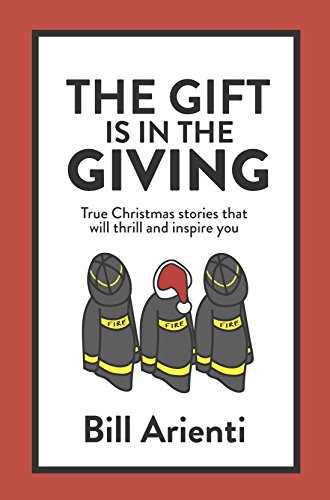
In the spirit of one of the most iconic Christmas stories of all time–The Gift of the Magi–The Gift is in the Giving by Bill Arienti sets out to show that giving a gift is more rewarding than receiving. A collection of stories amassed over years as a firefighter in Quincy, Massachusetts, Arienti captures in this book what's at the root of that feeling so many of us get around the holidays. It explores, in the context of Christmas, the selflessness, sympathy and sacrifice that our public servants gift to us all year round.
When I picked up this novel, I had the opportunity to meet the author at a book signing in a local shop. Had he not been there, I may not have even glanced at it, like so many other fantastic story collections. However, he looked kind and I wanted to hear his spiel about his new book, so I approached him. He told me all about himself, his work as a firefighter and what drove him to write this collection. I was interested to know about his holiday experiences in the field, so I asked him to sign a copy for me. My husband made me put the book aside so he could put it under the Christmas tree, a practice that is common in my house around the holidays. So, I had to wait.
A few weeks after Christmas passed, I finally had a chance to sit down with The Gift is in the Giving. I didn't have much time, but I whizzed through the first story in one sitting. I empathized with the two main characters, the author and a woman living in poverty. I think most people could see themselves in both the helper and the helpless. I was eager to hear more of the author's stories.
Next up was a tale about the author getting an opportunity to golf with one of Massachusetts' chosen ones–Bobby Orr. I wondered where this could possibly go and realized just what kind of guy was behind these stories when I found out. I was hooked and zoomed right through the rest of this short collection of short stories. I think you'll be just as eager to turn the page at the end of every story as I was.
Bill Arienti is a firefighter first. He hasn't spent decades of his life as a professional novelist. He's spent it helping out the people who need it, which makes this book all the more impressive. Arienti has a distinct writing style, and his voice comes through on every page. Every story has a clear message. If you enjoy collections like Chicken Soup for the Soul, you will not be disappointed.
Shelly Barclay
Showing posts with label Book Review. Show all posts
Novella Review: "Gwendy's Button Box" by Stephen King and Richard Chizmar
| Click image to see price on Amazon |
I'm going to spoil a few little things ahead. No biggies.
Gwendy's Button Box is about a gal named Gwendy who is putting forth a Herculean effort to lose weight by running up heart-attack inducing steps in her hometown when she meets The Man in Black. He's struck by something about her and decides to task her with safeguarding a strange box covered in buttons. Gwendy takes the challenge, little knowing that she's made a deal with the proverbial devil.
Like any good mysterious magical object, Gwendy's button box offers rewards and consequences. What's different about Gwendy's button box is that she can seemingly avoid the consequences if she is able to resist an almost supernatural urge to push the box's buttons. Soon, the novella becomes a tug of war between a growing young woman and the powers of the peculiar box. At first lacking in immediate threats to get the blood pumping, it isn't long before the sick imaginations of two accomplished writers are put to work.
Good co-writing makes it difficult, if not impossible, for the reader to tell who is at the wheel in any given section of the book. (I'm currently challenging myself to see where Owen King has taken the lead in Sleeping Beauties. I'm failing.) Whether the writers have done a great job of editing each other, have a solid sense of the work's voice or both, they manage to keep disbelief suspended with a fluid narrative. Chizmar and King do that wonderfully for Gwendy's Button Box. I'm hoping they decide to take on something a bit longer in the future.
Shelly Barclay
A Review of "The Night Circus" by Erin Morgenstern
| Click image to see price on Amazon |
Morgenstern's creativity shines through on every single page of this book. Sure, the plot doesn't race along, but I was happy to take my time with the bevy of unusual characters she designed and, above all, explore Le Cirque des Rêves–the eponymous night circus. She has a knack for strange romanticism, which limits the characters to some degree (they're all pretty, talented, etc.), but I think you'll be intrigued, even if everything is almost too lovely and magical.
At the center of our story are two magicians, pitted against each other from childhood, playing a game where neither knows the rules. The game board is Le Cirque des Rêves. As each of their skills grow, so too does the circus. It is filled with magical and mechanical feats, but visitors only know that they are drawn to its wonders. Decked out in black and white with only the rare splash of color, its decor alone is enough to make it stand out. It's a place like Hogwarts. I know it isn't real, but I want to spend my next vacation there.
There are some books that have such deep characters that you are moved along by them. Some have amazing settings that pull you in. Rare few fantasy novels have both. For me, The Night Circus was all about the setting. A few characters, particularly the twins, captured more than my passing interest, but I was distracted always by descriptions of snow-blanketed tents, gravity-defying cloud mazes, shape-shifting gowns and masterful clockworks. Morgenstern really nailed this place. I kind of hate that it isn't real.
My final word is fantasy lovers should read this book. Romance lovers will probably like it too, though I think it isn't quite a romance. Take your time. Enjoy the imagery. I know I did.
Shelly Barclay
Let's Review "Let's Pretend This Never Happened: A Memoir" by Jenny Lawson
| Click image to see price on Amazon |
Lawson is a Texas gal born to a taxidermist and his long-suffering wife. In Let's Pretend This Never Happened, she takes us through some often hilarious and sometimes worrisome misadventures with wild creatures–both alive and in various states of death. I say states of death because dead animals, in Jenny's household, could be dead, disemboweled or reanimated as a cutesy wall or desk ornament. She is both horrified by and okay with the live random bobcats and turkey stalkers as well as large animal corpses hanging out around her house.
Jenny Lawson has about as many health problems as an inbred show dog. That's not to say that she's inbred, though she is from Texas. (Come on. Low-hanging fruit!) You can't help but feel sorry for her as she navigates her way through rare disorders, mental illnesses and even rheumatoid arthritis. If she ever gets a break, it's probably going to need an x-ray.
Somehow, in spite of the wacky family, or maybe because of it, Jenny Lawson is able to pull through an eating disorder, failed pregnancies, being a human pincushion to have a baby, a marriage with some kind of financial professional, being a mother, having OCD and even vultures trying to eat her zombie dog. Her memoirs show that sometimes strong stuff is made of chipped and cracked glass. They prove that even women without pajama sets can make friends with other women. They make you feel like trying harder because if Jenny Lawson can have a popular blog, bestsellers and a driver's license, you can definitely get off your ass and take that cooking class.
Now, all I want to do is praise Lawson's bravery in baring her soul for the world to see, even if she does exaggerate. However, I would be remiss if I didn't warn you that this Let's Pretend This Never Happened goes a million miles a minute, which isn't necessarily a bad thing. I can't even imagine what it looked like before an editor got his hands on it. You have to work hard to keep up, but that's okay. It's worth charging through the author's thought process to get to the tales of laughter and woe that lie beneath.
Shelly Barclay
Book Review: "Fried Green Tomatoes at the Whistle Stop Cafe" by Fannie Flagg
| Click image to see price on Amazon |
Years ago, I watched the movie Fried Green Tomatoes for the first time. More than a stereotypical chick flick, this movie was funny, energetic and wholesome while tackling heavy topics. It's always been one of my favorites, yet I somehow never knew it was adapted from a novel. I learned that a few weeks ago when my sister asked me if I wanted to borrow Fried Green Tomatoes at the Whistle Stop Cafe by Fannie Flagg from her before she dug into it. Of course, I jumped at the opportunity and here I am.
At its core, Fried Green Tomatoes at the Whistle Stop Cafe is about a woman named Idgie and her family. Idgie's sister-in-law narrates some of the story while telling tales of her life to her friend in the nursing home. However, there is much more to it than the core tale. While jumping around from the past to the future and back again at odd points, this book encompasses a lot of folks, all Southern and all just a little countrified.
In contrast to Idgie's adventurous and daring spirit, there is Evelyn Couch–a modern housewife struggling through menopause and a crippling lack of confidence. Her friend Ninny is a bit like Idgie and encourages Evelyn to be herself and find help for her health issues. While Ninny often narrates some of the story of her friends and family's history, the book also slips into third-person, so the reader can get a glimpse of events Ninny didn't see, from murders to elephant marches. Also intertwined with these stories are fictional clippings from local newspapers involving characters and settings. I wasn't expecting that, and they proved to be quite funny at times.
Idgie is the soul of the novel and her soul mate is a woman named Ruth. I was a little surprised at how casually Fannie Flagg handled the fact that Ruth and Idgie were obviously gay. People around them knew it and this is Depression-era Alabama. I'm not entirely sure if people in that time and place would have been as accepting of such a relationship as the characters in the novel are or if Flagg wanted to leave that kind of bigotry out of the novel. In any event, it doesn't seem out of place.
There are a number of black characters in Fried Green Tomatoes at the Whistle Stop Cafe. Some are staff and all are friends of the central cast of characters. Bigotry and racial violence is handled extensively and I think tastefully. From the shame of being thought an Uncle Tom to the added difficulties of being black, homeless and hungry during the Depression, readers get what feels like an inside look into life before Civil Rights. It feels genuine and thoughtful at every step.
Homelessness, alcoholism, spousal abuse, disability and loss are all interwoven into this otherwise uplifting novel. Love, affection, unconditional friendship and humor all appear to counterbalance these difficult, but relevant issues. For me, humor is what came through the most. A few tall tales, a parking lot run-in and some good food jokes all made Fried Green Tomatoes at the Whistle Stop Cafe a happy, inspiring novel that is well worth the attention it, and its silver screen counterpart, has garnered over the years.
Shelly Barclay
Review and Summary: "The Giver" by Lois Lowry
| Click image to see price on Amazon |
What can I possibly say about Lois Lowry's The Giver that hasn't already been said about this award-winning novel? Probably not much. Many a more astute reviewer has rattled on about it in the past decades. Nonetheless, I've set out to tell you about most of the books I read, so I'm going to do that now in the knowledge that you should just stop reading this and go read The Giver. Seriously.
*Some spoilers
I was born in the 80s and had a developed love of literature by the 90s. Lois Lowry was one of the first writers to hit me square in the feels. She did it with Number the Stars–a kiddo-friendly look at the horrors of the Holocaust. Because I loved that book so much as a kid, I determined to read The Giver long ago, but have only just got around to it. I shouldn't have waited.
They say there are no original ideas left, but I think there are a few that come close enough or are executed so well that it hardly matters. The Giver is a bit of both. For some reason, I was nostalgic for A Wrinkle in Time and 1984 when I read it. Neither had parallel stories, but a similar feel definitely permeated all three (only for a brief section in the case of A Wrinkle in Time). That nostalgic feeling was there, but the story was also so individual that I devoured it.
In a world filled with Sameness, a young man named Jonas is chosen to be the only one among his people with memories of suffering and joy. He is to receive all of the memories of their history by a man he comes to know as The Giver. The Giver labors under the weight of these memories and, while sympathetic with Jonas, is eager to relieve his pain. However, as Jonas learns the truth about his life, he and The Giver must decide if it's time to release their burden.
The Giver is a short, simple read with complex, thought-provoking themes. Yes, it is categorized as children's literature. It's not. It is a book that people of most age groups can appreciate that happens to be at an easy reading comprehension level. This novel moved me at the age of 33. I've been thinking about it since I completed it last night and will surely remember it fondly for the rest of my life.
Shelly Barclay
Book Review: Stephen King's "End of Watch"
| Click image to see price on Amazon |
*Some spoilers
End of Watch finds Bill (real name Kermit) and his
partner-in-crime-fighting Holly Gibney dealing with Bill's grim diagnosis of
pancreatic cancer and the reappearance of Brady Hartsfield in their lives.
Hartsfield, a serial killer who plowed down dozens of people in the first book
of the trilogy, is a near-vegetable at the local hospital. How is it that Bill
suspects the brain trauma patient in a recent rash of suicides?
Before End of Watch, King had largely refrained from the
more fantastic aspects of his imagination with this trilogy. We've been given
straight-up everyday evil against a flawed hero in two relatively normal,
though outstandingly written, detective novels. King opened up the floodgates
for the last hurrah, bringing back an old favorite of his–telekinesis.
Because of the supernatural twist hinted at in Finders
Keepers and delivered in End of Watch, Hodges finds himself in the most
challenging case of his busy retirement. Some might call it an easy way to
bring back a crippled antagonist, but I found Hartsfield too intriguing, too
disgusting to be done away with in a single book. It was fitting to have him
back too see how he would fare against an again weakened Hodges in a second
round.
I enjoyed the book on a few lazy days swinging in my hammock
this summer. As usual, I was thoroughly entertained by Mr. King and bummed out
when the book inevitably ended. I'll wrap this up by noting how much I loved
King's treatment of the ever-anxious Holly Gibney. I have an anxiety disorder
myself and enjoyed having a hero more on my level. I'm also very happy that
King touched on themes of suicide and then included an encouraging note to
those of us who struggle with those issues to seek help and be patient enough
for the good times to come back. I was truly moved.
Shelly Barclay
Book Review: "11/22/63" by Stephen King
| Click image to see price on Amazon |
On first glance, I was curious if this was another of Stephen King's forays into non-fiction. There is no denying that the man is fixated on an earlier, simpler America. Perhaps it was time for him to write facts about the times that inspired him. Was 11//22/6 something else like Richard Preston's The Hot Zone–a non-fiction book told like a novel? Was Stephen King combining fact and fiction? It turned out to be the latter.
King has obviously waded through a mountain of research to complete 11/22/63 and, as far as this history buff can tell, he never grievously deviates from the facts as we know them. In fact, he digs right into the gritty little details. One cannot help noticing that King seems to enjoy these details–the gritty story of the bad guy. He always has.
I will try to give away practically nothing about this book because I want you to read it. So, I will have to be cryptic. Yes, this book delves deeply into the assassination of President Kennedy, but more the events leading up to it. The central characters in the book are not historical figures. They are the usual fictitious small town, likeable, flawed characters you find in King's novels. They are in quite an unusual situation. The past and the present intertwine with love, loss and a struggle against the supernatural. There is also a brilliant nod to It in 11/22/63. If you are a fan, you cannot miss it.
When I first started reading, I thought that I was going to spend the whole time wanting to skip ahead to the moment King provoked us with. He certainly did not need this topic to sell books, so my only explanation is that he knew we would be itching to find out what happens in Dealey Plaza in Stephen King's imagination. However, to my surprise, I did not skip forward once. I wanted more to know how he got there than what happened once he did. I knew King was not going to do something crazy like change history . . . or was he? You will have to find out.
Update: The book was made into a very good miniseries. Check that out too, if you can.
Book Review: Mockingjay by Suzanne Collins
| Click image to see price on Amazon |
Spoilers ahead.
Mockingjay reintroduces us to the protagonist of the series–Katniss Everdeen. Rebels have rescued her and taken her to their underground bunker. They did not rescue her friend Peeta. This makes Katniss resentful of the rebels with whom she is now working. Katniss has been mistrusting and angry throughout the series, but she is now distrustful of the rebels too.
Rebel leaders want Everdeen to be the symbol of their rebellion–a propaganda tool that inspires fighters. Their methods are similar to those used by the enemy, which sheds light on the story's true moral conundrum. When both sides are killing for what they want, how can you tell which side is the right side? If you cannot gain freedom from murderous leaders without violence, how do you stop the violence once you have won? This is not a new concept in literature.
The plot of Mockingjay is not surprising. The first two books set it up, but that doesn't make it less entertaining. They way the characters come to the realization that they may be trading one dictator for another, and the way they deal with it, keeps the plot moving. The morals are deeper, and the protagonists more colorful than those in most current YA fiction. I think Collins put herself near the top of the genre with this series. Let's hope she has more books to offer.
Shelly Barclay
Book Review and Summary: "Taltos" by Anne Rice
| Click image to see price on Amazon |
Anne Rice’s novel, Taltos is centered on a family of
witches and a near extinct race of human-like beings, called the Taltos. Taltos is the final installment of the
Mayfair witch trilogy. This novel successfully wraps up the two previous novels
while introducing new characters and a fresh plot. Taltos can be read as a stand-alone novel, but readers who have
read The Witching Hour and Lasher will have a better understanding
of it.
The Taltos are a race of giants
that reach their full size within a few hours of birth. They are nearly
extinct, but two witches that mate and have the right genetics may produce a
Taltos. This is unheard of until Rowan gives birth to Lasher at the end of The Witching Hour. Lasher is actually
the ghost of a Taltos that has been haunting the Mayfair’s for centuries and
has managed to possess Rowan’s baby.
In the following novel, titled Lasher, Rowan is forced by her possessed
offspring to produce yet another one of these beings. Birthing the Taltos takes
a toll on Rowan’s health and she becomes very sick by the end of the novel. In
the end, Rowan's husband Michael kills Lasher and Rowan herself kills her other
offspring.
In the beginning of Taltos, Rowan is unwilling to speak. She
spends her days at the Mayfair mansion, staring off into space. Rowan
eventually snaps out of it when she discovers that her friend Aaron has been
murdered. Rowan also comes to the realization that her thirteen-year-old
cousin, Mona is pregnant with Michael’s child. This causes the Mayfairs
considerable concern as Michael was the man who fathered Lasher and Mona is
capable of bearing a Taltos.
Rowan decides to take Michael on
a trip to avenge Aaron’s death, not knowing what is to become of Mona and the
baby. The Mayfairs discover that members of Aaron’s scholarly order, the
Talamasca, may have been responsible for his death. Rowan is determined to find
these men and bring them to justice. At
the outset of their search, they discover another Taltos by the name of Ashlar.
Until this point it is believed
that the Taltos had been completely wiped out. It turns out that Ashlar has
walked the Earth since before mankind and he knows first-hand the history of the Taltos. He joins Rowan and
Michael on their quest. He is convinced that there are only a few members of
the Talamasca involved.
The trio soon becomes friends
and they are able to restore order in the Talamasca and avenge Aaron’s death.
After the adventure is over, Ashlar decides to tell his new friends the long,
sad story of his life.
Ashlar tells the story of how
his native land was destroyed by a natural disaster and how his people were
forced to move to colder climes, specifically Europe. Ashlar becomes the leader
and hero of his people. They begin building stone circles and eventually
Stonehenge itself. Some time later the Taltos begin warring with the humans.
The Taltos are unable to defend themselves and
are forced into hiding. Ashlar remains their leader, and the race is eventually
able to disguise themselves among humans. Ashlar later finds religion and aids
in the slaughter of those Taltos who would not convert to Christianity. He is
tormented by his mistake and cursed by his people. Over time the entire race
appears to be wiped out and Ashlar spends centuries searching for others like
him. He was painfully lonely, but successful at passing for human.
While Ashlar is in New York
telling this story to Rowan and Michael, Mona gives birth to a female Taltos,
named Morrigan, in New Orleans. Rowan and Michael return home a few days later
and discover what has happened. They decide to keep Morrigan a secret from
Ashlar until she is older. Five days later, Ashlar begins missing his new
friends and decides to stop in for a visit. He sees Morrigan. The two run away
together immediately. Rowan and Michael appear to understand, but Mona is
devastated.
Taltos is far more in depth and intricate than can possibly be
conveyed here. Anne Rice did a magnificent job of constructing the plot and
characters of Taltos. Once again Anne
leaves her readers wishing that her book was just a little longer.
Shelly Barclay
Book Review and Plot Summary: "Lost Horizon" by James Hilton
| Click image to see price on Amazon |
At the start of the main story
of "Lost Horizon", a soldier named Hugh Conway finds himself aboard a
military aircraft with three other passengers, Roberta Brinklow, Henry Barnard
and Charles Mallinson. A short way into their journey they realize that their
plane has been hijacked. The hijacker has been flying the plane since takeoff
and they are now far off course. The man has a gun and is refusing to allow the
passengers to leave the plane, even when he stops for fuel.
The reader quickly finds that
the main character, Hugh Conway, is a man who rolls with the punches. The
situation hardly disturbs him and his fellow passengers seem to admire him for
what they view as bravery, Hugh on the other hand considers it laziness.
Mallinson soon reveals himself to be the malcontent of the group, while Barnard
is the adventurous American. Roberta Brinklow is a missionary who seems to be a
very practical woman, even if she is stiflingly religious.
Their plane ride abruptly ends
in Kuen-Lun mountain range in Tibet when their kidnapper lands the plane in the
midst of the mountains. The kidnapper dies soon after the difficult landing
without revealing to them the reason for the kidnapping. They have no food and
are ill-equipped for a jaunt through the snowy mountains of Tibet.
They spend the first night in
the aircraft and wander out into the daylight the following morning to get a
better look at their surroundings. They see a group of men coming toward them
down a mountain slope. When the men reach them, the companions are curious if
they will guide them to food and shelter, the men agree. One of the men speaks
English and they soon learn that these men are Tibetan and Chinese monks.
The monks take them on an
arduous climb up a mountain pass. After hours of climbing they reach their
destination, a Tibetan Lamasery in the valley of Shangri-la. The travelers are
quickly fed, bathed and otherwise made comfortable. The travelers are eager to
leave, with the possible exception of Conway. They ask Chang (the
English-speaking monk), if they will be able to procure a guide for the
difficult journey out of the mountains. Chang is very cryptic in his responses.
The only answer he gives is that porters will be arriving sometime soon and
that they might possibly guide them out.
Conway quickly begins to like
the lamasery and enjoy the peaceful surroundings of Shangri-la. Roberta begins
to see a need for a missionary of the Christian persuasion in Shangri-la and
she slowly decides to stay. The reader soon discovers that Barnard is a wanted
man, so he is easily persuaded to remain as well. Mallinson however cannot bring
himself to enjoy the lamasery and refuses to stay any longer than he absolutely
has to. This complicates things when Conway befriends the High Lama and learns
that they were kidnapped for the purpose of remaining at Shangri-la. Conway
keeps this secret and befriends the High Lama.
The High Lama begins to tell
Conway the story of his life at Shangri-la. The man claims to have lived for
hundreds of years and tells Conway that he will too if he stays at the lamasery.
It seems that all of the inhabitants of the lamasery have lived well beyond
their years and look much younger than they are. The catch to all of this
is that if any of them go further away than the valley their years will
immediately catch up to them. Even in the valley they must return to the
lamasery after a period of time.
Shortly after Conway learns all
of this the High Lama dies. It seems to the reader then that Conway has
resigned himself to stay at Shangri-la and live the long and peaceful life of
its inhabitants. Then Conway is confronted by Mallinson who says that he has
arranged for the porters to guide them off of the mountain immediately. The
others have already decided to stay so it is only Mallinson, Conway and a
seemingly young woman from the lamasery. Conway refuses, but when Mallinson
comes back to inform Conway that he can’t leave without him, Conway gives in.
At this point the main part of "Lost
Horizon" ends and the reader returns to the meeting of two friends
concerning Conway. This meeting only gives us small bits of information about what may have happened to Conway. It seems one of the friends has
seen Conway and heard his story, but that Conway has disappeared once again.
The friend made several enquiries about Conway, but only came up with
information at a hospital in Tibet. A hospital worker saw Conway shortly after
his descent form the mountain, the worker says that he appeared with an old
woman who died shortly thereafter.
This leaves you to wonder what
happened to Mallinson. Also was this old woman the very same woman who was
young before they left the valley? Is it possible that the High Lama was
telling the truth or did Conway lose both of his traveling companions and the
old lady was a good Samaritan who found him? Hilton never explains and you
never find out if Conway returned to Shangri-la, though you get the sense that
he did.
Shangri-la first appeared to the
public in James Hilton’s "Lost Horizon", which was published in the
1930's. Since then, this fictional valley has become synonymous with paradise.
In fact, I’ve met readers who haven’t read "Lost Horizon" and many
believe that Shangri-la is an ancient myth. However, this paradise that is
perceived really doesn’t exist in "Lost Horizon". James Hilton spends
very little time explaining this valley, the novel is more about moderation,
aversion to war and the subtle relationships between human beings than it is
about paradise.
Shelly Barclay
Jules Verne's "Around the World in Eighty Days": Plot Summary and Review
| Click image to see price on Amazon |
"Around the World in Eighty
Days" begins with a thorough description of the novel’s main character–Phileas Fogg. Fogg is described as being unusually preoccupied with timeliness.
He plans every bit of every day and has, thus far, never deviated from this
schedule as far as anyone can tell. At the point where we meet Fogg he is in
need of a new servant; his last one made the grave mistake of bringing him
shaving water that was eighty-four degrees rather than the specified
eighty-six. At this point the reader does not know what to make of Fogg. He is
a rather eccentric and punctual man. However, we see no evidence that he is
anything but good.
Fogg’s new servant, Jean
Passepartout, arrives at his home at precisely twenty-two minutes after eleven
on the first day of the story. Jean is quite pleased with his master and his
new station, because he wishes to settle down and he has heard that Fogg
rarely, if ever, travels. Fogg tells Passepartout to settle in and then sets
out for his gentleman’s club at the same exact time that he does this every
day.
Passepartout has begun settling
in when Fogg, breaking his careful schedule, arrives home hours before he is
expected. Fogg informs Passepartout that they will be going on a trip around
the wold and that they are to be leaving immediately. Fogg has bet his friends
at the club a great deal of money that he can make the journey in eighty days.
Passepartout is flabbergasted, but he follows his master’s lead.
At the outset of their adventure, everything goes according to plan. Then, unbeknownst to the pair, Fogg is
mistaken for a bank robber. The man who has mistaken him is a policeman named Fix.
Fix believes that Fogg is covering his escape with a fictional journey. Fix
resolves to arrest him, but he has no warrant and is forced to follow them. The
policeman manages to cause them many holdups throughout the novel, for which he
is attacked once by Passepartout and punched once by Fogg.
While the pair is in India the
train they are riding on runs out of tracks and they are forced to purchase an
elephant and hire a guide. While riding across India, they learn of a woman who
is about to be sacrificed at her husband’s funeral. At this point it becomes
obvious that Fogg is a good man despite his eccentricities, because he decides
that they should rescue the girl. Through a trick of Passepartout’s they are
able to save her and the young woman, Aouda, joins them on their adventure.
From here on the journey takes a
number of unexpected turns, Fogg is arrested twice, once with Passepartout,
they are attacked by native Americans, Passepartout joins the circus (kind of)
and Fix arrests Fogg. In the end, the real thief is caught and Fix, who isn’t so
bad, is forced to apologize.
After the arrest, Fogg believes
all is lost because he has been kept past his projected time of arrival. He is
depressed about this when Aouda approaches him and tells him she is in love
with him and that she wants him to marry her. He agrees and sends Passepartout
to get a priest so that they may marry the following day, Sunday. Passepartout
returns with the news that tomorrow is in fact Saturday and that they are still
in time. This was made possible because they gained a day in traveling the
globe to the east.
Shelly Barclay
Book Review: "Finders Keepers" by Stephen King
![]() |
| Cover art used under fair use Copyright held by publisher or artist |
"Finders Keepers" is the sequel to "Mr.
Mercedes" and the second in what will become a trilogy in the summer of
2016. Unlike "Mr. Mercedes," "Finders Keepers" focuses on an unfortunately fortunate kid and an author killer who has just been let
out of prison. However, Bill Hodges and his friends return as a major part of
the novel, as does the Mercedes Killer himself, tying it all together in a neat
little package.
Mild spoilers ahead.
It's no secret that I like Stephen King's style a lot.
However, as I've said before, I don't like every single one of his novels, but
I like this one. Hodges comes back in trimmer shape after suffering a heart
attack at the end of the last novel. He and his neurotic partner started up a
private detective agency called Finders Keepers. They are brought into a bigger
case than they imagine when a friend's younger sister shows up at their office.
Central to the story is Peter Saubers, a boy who unwittingly
made a discovery that may have saved his family from abject poverty and the
dissolution of his parents' marriage. However, this find has some serious
history that is about to come back to haunt young Peter.
The novel follows the original owner of Peter's discovery
and Peter as one tries to find what he buried decades earlier and the other
tries to help his family stay above water. It's easy to care about the
characters, with the exception of the very bad man. The plot is well paced, and
there was a serious teaser for the next novel that has me very excited. I
venture to guess that will be the best and most Stephen King-esque of the
bunch.
Shelly Barclay
Subscribe to:
Posts (Atom)

