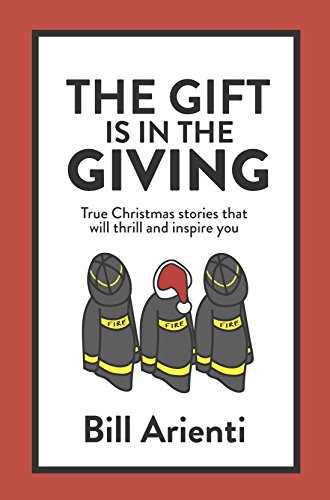
In the spirit of one of the most iconic Christmas stories of all time–The Gift of the Magi–The Gift is in the Giving by Bill Arienti sets out to show that giving a gift is more rewarding than receiving. A collection of stories amassed over years as a firefighter in Quincy, Massachusetts, Arienti captures in this book what's at the root of that feeling so many of us get around the holidays. It explores, in the context of Christmas, the selflessness, sympathy and sacrifice that our public servants gift to us all year round.
When I picked up this novel, I had the opportunity to meet the author at a book signing in a local shop. Had he not been there, I may not have even glanced at it, like so many other fantastic story collections. However, he looked kind and I wanted to hear his spiel about his new book, so I approached him. He told me all about himself, his work as a firefighter and what drove him to write this collection. I was interested to know about his holiday experiences in the field, so I asked him to sign a copy for me. My husband made me put the book aside so he could put it under the Christmas tree, a practice that is common in my house around the holidays. So, I had to wait.
A few weeks after Christmas passed, I finally had a chance to sit down with The Gift is in the Giving. I didn't have much time, but I whizzed through the first story in one sitting. I empathized with the two main characters, the author and a woman living in poverty. I think most people could see themselves in both the helper and the helpless. I was eager to hear more of the author's stories.
Next up was a tale about the author getting an opportunity to golf with one of Massachusetts' chosen ones–Bobby Orr. I wondered where this could possibly go and realized just what kind of guy was behind these stories when I found out. I was hooked and zoomed right through the rest of this short collection of short stories. I think you'll be just as eager to turn the page at the end of every story as I was.
Bill Arienti is a firefighter first. He hasn't spent decades of his life as a professional novelist. He's spent it helping out the people who need it, which makes this book all the more impressive. Arienti has a distinct writing style, and his voice comes through on every page. Every story has a clear message. If you enjoy collections like Chicken Soup for the Soul, you will not be disappointed.
Shelly Barclay
Showing posts with label Short Stories. Show all posts
Short Story Review: Massinello Pietro by Ray Bradbury
| Click image to see price on Amazon |
Massinello Pietro loves animals, music and dancing. His love for these things is unswayed by complaints from his disgruntled neighbors and even threats from the police. He keeps far too many pets that make a lot of noise. He plays his music at all times of the night, much to the chagrin of the neighborhood. He refuses to stop, no matter how many complaints he gets. His reasoning is that it makes him happy. As the story wears on, the reader comes to realize that he is not so much being inconsiderate of others as he is being considerate of himself. He is tired of the unhappiness that life can bring, so he resolves to suck himself out of the mire of the human condition and make his own conditions.
Ray Bradbury keeps this story short and simple. He gives the reader an eccentric, likable and pitiable character. He gives us page after page of validation for the complaints of the man's neighbors, but then he gives us validation for the man himself. He also shows us that, in the end, the polite, happy-go-lucky man was actually of value to those who were annoyed by him. In the end, his presence had been normalcy to them. Without him, things are wrong.
Review and Summary of "The Beast in the Cave" by H.P. Lovecraft
While H.P. Lovecraft is one of the reigning, though deceased, kings of horror, there were definitely trends in his work that bordered on repetition. You can chalk this up to him being one of the universe creators of horror. You would frequently see cities of a time long past or glimpses of other worlds. There was something, to use one of his favorite words, phantasmagorical about his work. As much as I love these stories from Lovecraft, I enjoy "The Beast in the Cave" all the more for its break from this trend. Do not worry. You will still recognize his handiwork, but you may find it hard to believe that this short story was written in 1905. Lovecraft was only 14 at the time.
[Spoilers ahead]
The entirety of "The Beast in the Cave" takes place in Kentucky in the company of the nameless narrator. He is stumbling through Mammoth Cave with a dying torch after having lost his tour group. You learn that he has been lost for many hours and considers his plight terminal. This deep in the caves, even a guide would have a difficult time finding a way out. This setting is perfect for a story wrought with cloying claustrophobia.
As you may have guessed, our narrator soon encounters a beast. Well, he hears what he thinks is a beast. It is walking on all fours and padding along behind the lost tourist. We join the narrator in his head while he ponders what could possibly be this deep into the caves and how being lost from the light may have affected any creature so beset by tragedy. Soon, our hero loses his light and finds himself cornered. The creature comes ever closer as the man reaches for a rock, throws it and incapacitates his tormenter.
Surely, that is a creepy enough story, but not for a teenaged H.P. Lovecraft. The guide, after noticing one of his charges went missing, goes searching for the narrator. They meet just after the confrontation with the so-called beast. As the guide sheds a light on the thing, which they can tell is expiring by its breathing, the two men realize with horror that what was chasing the lost tourist was his fate were he to have remained too long in the cave. It was a beast all right, but a beast that was once human and had changed with the lightless ecosystem of Mammoth Cave.
If you are just starting off with Lovecraft, this is as good a place as any. The story is just a few pages, is not as wordy as some of the adult Lovecraft's stories and does not fail to chill.
Shelly Barclay
[Spoilers ahead]
The entirety of "The Beast in the Cave" takes place in Kentucky in the company of the nameless narrator. He is stumbling through Mammoth Cave with a dying torch after having lost his tour group. You learn that he has been lost for many hours and considers his plight terminal. This deep in the caves, even a guide would have a difficult time finding a way out. This setting is perfect for a story wrought with cloying claustrophobia.
As you may have guessed, our narrator soon encounters a beast. Well, he hears what he thinks is a beast. It is walking on all fours and padding along behind the lost tourist. We join the narrator in his head while he ponders what could possibly be this deep into the caves and how being lost from the light may have affected any creature so beset by tragedy. Soon, our hero loses his light and finds himself cornered. The creature comes ever closer as the man reaches for a rock, throws it and incapacitates his tormenter.
Surely, that is a creepy enough story, but not for a teenaged H.P. Lovecraft. The guide, after noticing one of his charges went missing, goes searching for the narrator. They meet just after the confrontation with the so-called beast. As the guide sheds a light on the thing, which they can tell is expiring by its breathing, the two men realize with horror that what was chasing the lost tourist was his fate were he to have remained too long in the cave. It was a beast all right, but a beast that was once human and had changed with the lightless ecosystem of Mammoth Cave.
If you are just starting off with Lovecraft, this is as good a place as any. The story is just a few pages, is not as wordy as some of the adult Lovecraft's stories and does not fail to chill.
Shelly Barclay
Short Story Review: "The Lottery" by Shirley Jackson
"The Lottery" by Shirley Jackson is one of the most chilling short stories of the 20th century. It is not horror, but it is horrifying. It is not religious, but it is a commentary on blind tradition. It is not violent, but it hints at a violence that is intolerable to most of us. All in all, it is just a few pages that are well worth the effort it takes to read them. The brevity itself lends yet another element to the story, as it amazingly needs no more words to say quite a lot.
This paragraph is going to be a bit of a spoiler. Sorry, it is hard to write about such a short story without spoiling anything. You can go ahead and skip to the next. I promise I will stop my spoiling short of the next paragraph. "The Lottery" surrounds an eponymous event that is described with such complete lack of emotional involvement by the writer that the reader is forced to draw all of their own conclusions about emotions and morality with the sudden realization that comes at the end -- these casually talking people are figuratively drawing straws on who is going to get stoned to death and no one is going to stop short of throwing stones, even if it is at Mommy. It adds up to a scathing, though utterly simple, look at the ignorance of blindly following tradition for the sake of tradition.
There is not much to say about "The Lottery" that the story does not say for itself. Jackson used as few words as possible to tell a story that is much more complex in its ideas than it is in its scope. It is one of the few stories that cannot be properly dissected in fewer words than the story itself. I really have no words for the level of sophistication in simplicity that she achieved and can only urge you to read this story, if you have not yet done so.
Shelly Barclay
This paragraph is going to be a bit of a spoiler. Sorry, it is hard to write about such a short story without spoiling anything. You can go ahead and skip to the next. I promise I will stop my spoiling short of the next paragraph. "The Lottery" surrounds an eponymous event that is described with such complete lack of emotional involvement by the writer that the reader is forced to draw all of their own conclusions about emotions and morality with the sudden realization that comes at the end -- these casually talking people are figuratively drawing straws on who is going to get stoned to death and no one is going to stop short of throwing stones, even if it is at Mommy. It adds up to a scathing, though utterly simple, look at the ignorance of blindly following tradition for the sake of tradition.
There is not much to say about "The Lottery" that the story does not say for itself. Jackson used as few words as possible to tell a story that is much more complex in its ideas than it is in its scope. It is one of the few stories that cannot be properly dissected in fewer words than the story itself. I really have no words for the level of sophistication in simplicity that she achieved and can only urge you to read this story, if you have not yet done so.
Shelly Barclay
Short Story Review: "The Fog Horn" by Ray Bradbury
"The Fog Horn" by Ray Bradbury is quite short, even for a short story, but it combines several themes that result in a story that is both unusual and thought provoking. Anyone with a heightened interest in classic literature has come across the lighthouse keeper stories, sea serpent stories, man against wild stories and sad tales of a beast that is the last of its kind, but, to my knowledge, there is no other that brings together all of these elements.
It takes only a page for Bradbury to hint at something strange and perhaps one or two more to bring it right to the reader. There is no real interaction with the antagonist of the story. The narrator and his companion can only watch and experience the strangeness of an ancient beast and how a fog horn breaks its heart.
There are two reasons you should give "The Fog Horn" a chance. Firstly, this is Ray Bradbury. If he has ever had a miss, I have not yet seen it. Secondly, it is so short that you have barely any time to lose.
Shelly Barclay
It takes only a page for Bradbury to hint at something strange and perhaps one or two more to bring it right to the reader. There is no real interaction with the antagonist of the story. The narrator and his companion can only watch and experience the strangeness of an ancient beast and how a fog horn breaks its heart.
There are two reasons you should give "The Fog Horn" a chance. Firstly, this is Ray Bradbury. If he has ever had a miss, I have not yet seen it. Secondly, it is so short that you have barely any time to lose.
Shelly Barclay
Short Story Review: "Dreams of Virginia Dare" by John P. O'Grady
"Dreams of Virginia Dare" by John P. O'Grady is one of the short stories in the anthology "Otherworldly Maine." It shares the book with such names as Mark Twain and Stephen King and is somewhat outshined by these others, to be honest.
"Dreams of Virginia Dare" starts off and gets its footing on a web of American history. Set in Maine, it draws from tales of Boston and even further south, the lost Roanoke Colony. The name Virginia Dare comes from the first child born to those colonists -- a little girl who was lost to history along with her family and neighbors. This, and the addition of allusions to magic, got "Dreams of Virginia Dare" off to a running start. It was mysterious, strange and very . . . Maine.
Before I dive into where it went wrong for me, I should mention a little more of where it went right. It was realistic, an area where many stories fail. It was explanatory and amusing in a "look what the years reveal" sort of way. However, it was also anti-climactic. It was as if it started from the end and worked its way to the beginning in terms of experience.
"Dreams of Virginia Dare" by John P. O'Grady" was a short read, compared to the other stories in the anthology. While I would not seek it out on its own merit, I certainly would not suggest skipping it when reading this anthology. It has good moments and is over rather quickly, so it is hardly a waste of time to give it a chance.
Shelly Barclay
Summary and Review of "The Jaunt" by Stephen King
"The Jaunt" by Stephen King is my personal favorite short story from him. It has elements of both horror and science fiction. In it, Stephen King takes the well-known science fiction concept of teleportation and turns it into a futuristic horror story. A lot of what is the "horror" in this story is left to the imagination, but what we do know of that horror is so mind boggling that it is one of the most powerful concepts King has ever come up with.
The name of the story comes from the name teleportation is given in "The Jaunt." The story begins as a man, his wife and their two children are getting ready to teleport or "jaunt" from the Earth to Mars. The man has done this several times, but his children are new to it and so he decides to tell them the history of the jaunt. King takes the reader back to the 1980s and a fictional Earth where resources are dangerously low and starvation is spreading like an epidemic across the globe. An old, eccentric scientist is trying to develop a means of teleportation to solve all of these problems and he is successful. However, there is a problem.
When the scientist puts his test mice through his teleportation device, they come back dead or near dead. The ones that come back near death exhibit strange behavior. As the story progresses, the reader learns that the body teleports in mere seconds, but those seconds are an eternity to the mind. The problem is fixed by putting anything that is jaunting alive to sleep before teleportation, including humans. The father knows horror stories of humans coming through the jaunt awake, but he keeps the sordid details from the children, allowing only the reader to know just how horrible the jaunt truly is.
*Spoiler ahead
Finally, as they wait to jaunt, the attendants come around to put the family to sleep. After a few moments, the father wakes up in Mars to the sound of his wife screaming. He goes to where his wife was pointing to see his son laying there with yellowed eyes and white hair. The boy yells to his father that he faked taking the gas to sleep and that it is longer than eternity in the jaunt before screaming and tearing at his eyeballs. The father refers to the boy as an old "it" inside of his son's body. King's description of this moment has stuck with me since the first time I read it so many years ago.
Shelly Barclay
The name of the story comes from the name teleportation is given in "The Jaunt." The story begins as a man, his wife and their two children are getting ready to teleport or "jaunt" from the Earth to Mars. The man has done this several times, but his children are new to it and so he decides to tell them the history of the jaunt. King takes the reader back to the 1980s and a fictional Earth where resources are dangerously low and starvation is spreading like an epidemic across the globe. An old, eccentric scientist is trying to develop a means of teleportation to solve all of these problems and he is successful. However, there is a problem.
When the scientist puts his test mice through his teleportation device, they come back dead or near dead. The ones that come back near death exhibit strange behavior. As the story progresses, the reader learns that the body teleports in mere seconds, but those seconds are an eternity to the mind. The problem is fixed by putting anything that is jaunting alive to sleep before teleportation, including humans. The father knows horror stories of humans coming through the jaunt awake, but he keeps the sordid details from the children, allowing only the reader to know just how horrible the jaunt truly is.
*Spoiler ahead
Finally, as they wait to jaunt, the attendants come around to put the family to sleep. After a few moments, the father wakes up in Mars to the sound of his wife screaming. He goes to where his wife was pointing to see his son laying there with yellowed eyes and white hair. The boy yells to his father that he faked taking the gas to sleep and that it is longer than eternity in the jaunt before screaming and tearing at his eyeballs. The father refers to the boy as an old "it" inside of his son's body. King's description of this moment has stuck with me since the first time I read it so many years ago.
Shelly Barclay
Review of "Cain Rose Up" by Stephen King
"Cain Rose Up" is a short (very short) story in Stephen King's "Skeleton Crew" anthology. It is the story of a young man who decides to go on a killing spree from the window of his college dorm. He uses a rifle that he snuck into the school. The interesting thing about King's rendering of the topic, and a common theme with this topic and Stephen King, is that the story does not drag you into the horror and sadness of victims. It brings you into the world of the killer, who you must presume is something of a victim himself.
The main character of "Cain Rose Up," Curt Garrish, says goodbye to some of his dorm mates, as it is the end of the year, makes some internal observations about them, locks his door, gets his gun and starts shooting out of the window. It really is that short of a story. In the end, you do not even know how far Curt eventually goes, though you know he already has a few victims. It takes a minute after reading the story to realize that it was a good story. It is so brief that you have so many questions, but then you find yourself answering all of those questions from experience. Unfortunately, college killing sprees are not fiction.
One of the main questions "Cain Rose Up" poses to the reader is why did Curt do it? People seem to want to talk to him, as evidenced by the dialogue in the story. He has a father who buys him things and he has good grades. His inner dialogue and visions are somewhat disturbing, but the reason for this and the reason he manifests them outside of his mind is never mentioned. This leaves the reader with the interesting opportunity to fill in the blanks.
Was Curt like Charles Whitman who had psychological issues, a brain tumor and a drug problem? Was he like Seung-Hui Cho, who had been rejected by girls and who had nursed his own psychological problems under his school's radar? You just do not know in this story. Like Lionel Shriver's "We Need to Talk about Kevin," "Cain Rose Up" reminds us that homicidal youths have a tendency to slip through the cracks.
Shelly Barclay
The main character of "Cain Rose Up," Curt Garrish, says goodbye to some of his dorm mates, as it is the end of the year, makes some internal observations about them, locks his door, gets his gun and starts shooting out of the window. It really is that short of a story. In the end, you do not even know how far Curt eventually goes, though you know he already has a few victims. It takes a minute after reading the story to realize that it was a good story. It is so brief that you have so many questions, but then you find yourself answering all of those questions from experience. Unfortunately, college killing sprees are not fiction.
One of the main questions "Cain Rose Up" poses to the reader is why did Curt do it? People seem to want to talk to him, as evidenced by the dialogue in the story. He has a father who buys him things and he has good grades. His inner dialogue and visions are somewhat disturbing, but the reason for this and the reason he manifests them outside of his mind is never mentioned. This leaves the reader with the interesting opportunity to fill in the blanks.
Was Curt like Charles Whitman who had psychological issues, a brain tumor and a drug problem? Was he like Seung-Hui Cho, who had been rejected by girls and who had nursed his own psychological problems under his school's radar? You just do not know in this story. Like Lionel Shriver's "We Need to Talk about Kevin," "Cain Rose Up" reminds us that homicidal youths have a tendency to slip through the cracks.
Shelly Barclay
Review of "The Monkey" by Stephen King
In "The Monkey" from "Skeleton Crew," Stephen King takes on the evil toy come to life genre with finesse. From films like Child's Play to stories like Algernon Blackwood's "The Doll," the idea of children's toys coming to life to terrorize their innocent owners is, well, horrifying. This may be because of the vulnerability of children and good parents' tendency to imagine the worst of even the most minor threats. It could also be because their lifeless eyes and mirthless grins haunt us from childhood. Whatever the reason, toys with faces are scary and no one does scary better than Stephen King.
The antagonist in "The Monkey" is, predictably, a toy monkey. You know the kind, the straight from the underworld mangy faces with the oval eyes, toothy grins and cacophonous clanging cymbals. King hints that this monkey started just like any other horrible gift idea of a toy monkey, but somewhere along the line, somehow, it took on a life and personality of its own. Without describing much more than its unwilling owner's perspective of the monkey, Stephen King manages to convey to the reader that the toy monkey is ruthless and insane. It enjoys horrifying a little boy and the man he becomes.
Brilliantly, Stephen King initially leaves the truth of the monkey's "personality" ambiguous. Is it the boy's imagination, a sane person has to wonder? However, by the end, our protagonist has proven himself to the reader and is now in a race to save the next generation of monkey owners from a mean spirited toy. In the end, the reader has a brief sense of relief. Our protagonist has won! Wait . . . is the monkey still making its deadly music? If not, what has become of the evil that lived inside of it?
Shelly Barclay
The antagonist in "The Monkey" is, predictably, a toy monkey. You know the kind, the straight from the underworld mangy faces with the oval eyes, toothy grins and cacophonous clanging cymbals. King hints that this monkey started just like any other horrible gift idea of a toy monkey, but somewhere along the line, somehow, it took on a life and personality of its own. Without describing much more than its unwilling owner's perspective of the monkey, Stephen King manages to convey to the reader that the toy monkey is ruthless and insane. It enjoys horrifying a little boy and the man he becomes.
Brilliantly, Stephen King initially leaves the truth of the monkey's "personality" ambiguous. Is it the boy's imagination, a sane person has to wonder? However, by the end, our protagonist has proven himself to the reader and is now in a race to save the next generation of monkey owners from a mean spirited toy. In the end, the reader has a brief sense of relief. Our protagonist has won! Wait . . . is the monkey still making its deadly music? If not, what has become of the evil that lived inside of it?
Shelly Barclay
Here There Be Tygers by Stephen King: Short Story Review
"Here There Be Tygers" is a short -- very short -- story from Stephen King's "Skeleton Crew." To be honest, I think the story is meant to speak to men and their boyhood journeys to the boys' bathroom in school. I say that because I can only imagine that there was something about the boys' bathroom that led Stephen King to write this unlikely story in which the antagonists are a teacher and a tiger.
A few things about this story are relatable. 1. The teacher knowingly embarrasses a child in front of the entire class. 2. The child is afraid to ask to go to the bathroom. 3. The child's inner dialogue switches between panic and inappropriate names for his mean teacher. All of these things are instantly recognizable from most of our childhoods. There were also a few things that were not quite understandable. 1. Is the boy confusing basement with bathroom or is he obsessing over the basement while going to the bathroom? 2. Is the boy's imagination overactive or are the of this world, but really odd events in the story actually taking place?
"Here There By Tygers" is so short and encased in such a wonderful short story anthology that one barely has time to question Stephen King before moving on to "The Monkey," which has haunted me since my teenage years. However, once you get the chance to sit back and think of it, assuming you remembered it after poring through the rest of "Skeleton Crew," you can't help but wonder about deeper meaning. I mean, there has to be a deeper meaning, right or did that just really happen in a school bathroom?!?!?!?! At least, was King trying to convey that it really happened or was he masking some kind of . . . Oh, forget it. One can only speculate. It will only take two minutes. Read it yourself and please tell me what you think.
Shelly Barclay
A few things about this story are relatable. 1. The teacher knowingly embarrasses a child in front of the entire class. 2. The child is afraid to ask to go to the bathroom. 3. The child's inner dialogue switches between panic and inappropriate names for his mean teacher. All of these things are instantly recognizable from most of our childhoods. There were also a few things that were not quite understandable. 1. Is the boy confusing basement with bathroom or is he obsessing over the basement while going to the bathroom? 2. Is the boy's imagination overactive or are the of this world, but really odd events in the story actually taking place?
"Here There By Tygers" is so short and encased in such a wonderful short story anthology that one barely has time to question Stephen King before moving on to "The Monkey," which has haunted me since my teenage years. However, once you get the chance to sit back and think of it, assuming you remembered it after poring through the rest of "Skeleton Crew," you can't help but wonder about deeper meaning. I mean, there has to be a deeper meaning, right or did that just really happen in a school bathroom?!?!?!?! At least, was King trying to convey that it really happened or was he masking some kind of . . . Oh, forget it. One can only speculate. It will only take two minutes. Read it yourself and please tell me what you think.
Shelly Barclay
Summary of Pater Caninus by Ray Bradbury
Pater Caninus is a short story in Ray Bradybury's We'll Always Have Paris. This short story sticks out among the rest as a story that looks deep into the self importance of human beings and the patience of our canine friends. It also sheds light on the men who dole out confessions to sinners and whether they have a monopoly on such things or not.
Pater Caninus is a simple story. The entire story takes place in one part of a presumably Catholic hospital that is apparently run by priests. The story begins when one priest points out to another priest that a dog who typically accompanies one of the fathers is at the hospital alone. The two men follow the dog and find that he is giving confession to the patients. He sits patiently and quietly while they confess their sins to him. When each patient is done, the dog puts his paw on their beds and goes to the next room.
The first priest is fascinated by this dog. He merely wanted to share the amazing canine with the other priest. However, the second priest is infuriated by the impression that the dog is somehow usurping his position as priest. He follows the dog to the door of the hospital and threatens to bring damnation upon the dog should it return. This mortifies the first priest, who points out that the dog was only doing what they themselves do. The second priest reiterates his sentiments.
On the suggestion of the first priest, the pair goes to see if what the dog was doing did any harm to their patients. He had not. In fact, the entire area had a feeling of peace. The second priest becomes ashamed of himself and sits in his office. Moments later, Pater Caninus walks into the room and the egotistical priest willfully confesses his sin in treating the dog as he had. That is the end of the story.
What is interesting about this story is that the dog appears to simply be mimicking the rounds of his master, who is a priest, but the effect that he has on the patients is the same. It is also quite true that a Catholic priest would find the idea of a dog giving confession to be offensive, as dogs reportedly do not have souls. The god of Catholics puts people on a pedestal above all other animals. However, this does not stop Ray Bradbury from creating a pair of priests who could see the goodness in the dog and the benefit that could be reaped by his company. Of course, Bradbury very well could have intended that this dog be taken as a priest of god, not just a dog spreading happiness and mimicking his master, but that is how I saw it. I saw it as a lesson in the importance of other creatures and in the importance of being humble, no matter how in with god you think you are.
Shelly Barclay
Pater Caninus is a simple story. The entire story takes place in one part of a presumably Catholic hospital that is apparently run by priests. The story begins when one priest points out to another priest that a dog who typically accompanies one of the fathers is at the hospital alone. The two men follow the dog and find that he is giving confession to the patients. He sits patiently and quietly while they confess their sins to him. When each patient is done, the dog puts his paw on their beds and goes to the next room.
The first priest is fascinated by this dog. He merely wanted to share the amazing canine with the other priest. However, the second priest is infuriated by the impression that the dog is somehow usurping his position as priest. He follows the dog to the door of the hospital and threatens to bring damnation upon the dog should it return. This mortifies the first priest, who points out that the dog was only doing what they themselves do. The second priest reiterates his sentiments.
On the suggestion of the first priest, the pair goes to see if what the dog was doing did any harm to their patients. He had not. In fact, the entire area had a feeling of peace. The second priest becomes ashamed of himself and sits in his office. Moments later, Pater Caninus walks into the room and the egotistical priest willfully confesses his sin in treating the dog as he had. That is the end of the story.
What is interesting about this story is that the dog appears to simply be mimicking the rounds of his master, who is a priest, but the effect that he has on the patients is the same. It is also quite true that a Catholic priest would find the idea of a dog giving confession to be offensive, as dogs reportedly do not have souls. The god of Catholics puts people on a pedestal above all other animals. However, this does not stop Ray Bradbury from creating a pair of priests who could see the goodness in the dog and the benefit that could be reaped by his company. Of course, Bradbury very well could have intended that this dog be taken as a priest of god, not just a dog spreading happiness and mimicking his master, but that is how I saw it. I saw it as a lesson in the importance of other creatures and in the importance of being humble, no matter how in with god you think you are.
Shelly Barclay
Short Story Review: The Murder by Ray Bradbury
The Murder by Ray Bradbury is an interesting suspense short story that borders on horror. It is far too short to say much about the plot without giving it away. However, suffice it to say that it is like a brief version of Poe's The Telltale Heart.
Like Edgar Allen Poe, Ray Bradbury uses the sense of dread and horror that all of us feel when confronted with something we see as supernaturally different. You almost have to assume that there is something supernatural happening in the story, though pretty much everything is left to the reader's imagination. Those of you who have sufficient imagination to fill in the gap that is presumably the torment of a kind man should read this story at your earliest convenience. In fact, you should just read Ray Bradbury's We'll Always Have Paris, which contains this story and others, and spare yourself having to read my sporadic reviews on the stories in it worth reviewing.
Shelly Barclay
Like Edgar Allen Poe, Ray Bradbury uses the sense of dread and horror that all of us feel when confronted with something we see as supernaturally different. You almost have to assume that there is something supernatural happening in the story, though pretty much everything is left to the reader's imagination. Those of you who have sufficient imagination to fill in the gap that is presumably the torment of a kind man should read this story at your earliest convenience. In fact, you should just read Ray Bradbury's We'll Always Have Paris, which contains this story and others, and spare yourself having to read my sporadic reviews on the stories in it worth reviewing.
Short Story Review: Massinello Pietro by Ray Bradbury
| Photo by Alan Light |
Massinello Pietro is a man who loves animals, music and dancing. His love for these things is unswayed by complaints from his disgruntled neighbors and even threats from the police. He keeps far too many pets that make a lot of noise. He plays his music at all times of the night, much to the chagrin of the neighborhood. He refuses to stop, no matter how many complaints he gets. His reasoning is that it makes him happy. As the story wears on, the reader comes to realize that he is not so much being inconsiderate of others as he is being considerate of himself. He is tired of the unhappiness that life can bring, so he resolves to suck himself out of the mire of the human condition and make his own condition.
In Massinello Pietro Ray Bradbury keeps this story short, simple and pleasant, if you enjoy nutty characters. He gives the reader an eccentric, likable and pitiable character. He gives us page after page of validation for the complaints of the man's neighbors, but then he gives us validation for the man himself. He also shows us that, in the end, the polite, happy go lucky man was actually of worth to those who were annoyed by him. In the end, his presence had been normalcy to them. Without him, things were wrong.
Shelly Barclay
Short Story Review: Pa's Darling by Louis Auchincloss
After cracking the spine of the 2007 edition of "The Best American Short Stories," the first story to greet me, after two introductions by the editors, was Pa's Darling by Louis Auchincloss. It was a thankfully brief 13 pages of well-written, if unmoving, narrative. Stopping short of being too critical, because the story does not deserve a heaping load of criticism, all that can be said is that the story lacks the emotional or societal scope that makes a short story really cling to you.
Louis Auchincloss has just the right amount of average and pretentious in her writing style to reach a wide audience with the right story. Unfortunately, this was not it. The characters were okay. The story was okay and the setting was, well, practically non-existent. She gave herself a wonderful opportunity by setting her tale between the 30s and the 60s. The only moving cultural reference to this tumultuous era is the death of the narrator's husband in World War II, which is very underplayed.
The title character, who was not as darling as Pa liked to tell everyone she was, is essentially complaining about her father and her two husbands. She even gets a dig at her mother. That is the beginning, middle and end. There is a little precedence for it. However, her complaints are hardly fetching. There is nothing about her story that hits the reader hard. Perhaps that is simply what I want from a short story -- thought-provoking brevity. I want to be moved or made to ponder concepts familiar or unfamiliar to me. Pa's Darling could not do that with its unfortunate lack of climax or purpose. There is a complete lack of tangible climax, for the reader and the narrator's father.
With all of the above being said, Pa's Darling was simply not for me. Perhaps it would be better for someone who can relate to a the ponderings of a rich girl who is not content with the level of her father's love, the just barely sordid secrets of her mother and the shortcomings of her two hard-working and polite husbands. For me, I will take a more powerful, earthy and realistic antagonist than a pompous, but outwardly loving father any day. As for the protagonist, I would hardly call an ungrateful rich girl that.
Shelly Barclay
Louis Auchincloss has just the right amount of average and pretentious in her writing style to reach a wide audience with the right story. Unfortunately, this was not it. The characters were okay. The story was okay and the setting was, well, practically non-existent. She gave herself a wonderful opportunity by setting her tale between the 30s and the 60s. The only moving cultural reference to this tumultuous era is the death of the narrator's husband in World War II, which is very underplayed.
The title character, who was not as darling as Pa liked to tell everyone she was, is essentially complaining about her father and her two husbands. She even gets a dig at her mother. That is the beginning, middle and end. There is a little precedence for it. However, her complaints are hardly fetching. There is nothing about her story that hits the reader hard. Perhaps that is simply what I want from a short story -- thought-provoking brevity. I want to be moved or made to ponder concepts familiar or unfamiliar to me. Pa's Darling could not do that with its unfortunate lack of climax or purpose. There is a complete lack of tangible climax, for the reader and the narrator's father.
With all of the above being said, Pa's Darling was simply not for me. Perhaps it would be better for someone who can relate to a the ponderings of a rich girl who is not content with the level of her father's love, the just barely sordid secrets of her mother and the shortcomings of her two hard-working and polite husbands. For me, I will take a more powerful, earthy and realistic antagonist than a pompous, but outwardly loving father any day. As for the protagonist, I would hardly call an ungrateful rich girl that.
Shelly Barclay
Willa by Stephen King from Just After Sunset
| Click image for price on Amazon |
Willa starts as the story of a man whose wife has left the little station where they were waiting for a train. He goes out looking for her and learns an astonishing truth when he finds her. Truth be told, there simply was not enough build up to this revelation for it to be shocking or even enjoyable. I was unable to relate to the characters, due to a lack of depth. Nonetheless, the story was a Stephen King story and so it was not terrible by a long shot.
I will keep this review short, as Willa itself is very short. I will add that there is some imagery in the story that is creepy, so it makes it readable (of course). Oh, and one cannot forget the token creepy little girl.
Shelly Barclay
Subscribe to:
Posts (Atom)