Showing posts with label Jane Austen. Show all posts

Character Analysis of Elizabeth Bennet in "Pride and Prejudice" by Jane Austen

Elizabeth Bennet, also known as Lizzy and Eliza, is the main character of Jane Austen's Pride and Prejudice. She is the daughter of Mr. and Mrs. Bennet, the younger sister of Jane Bennet and the older sister of Mary, Catherine and Lydia Bennet. The story revolves around her as she seeks to find answers to life's difficult questions regarding love, morality, manners, upbringing, social status and more.

*Mild spoilers ahead.

Elizabeth lives with her parents and all of her sisters in the family home, Longbourn. Her father is a country gentlemen of no great wealth who enjoys reading and teasing his wife and three youngest daughters. Her mother is a silly woman who is an unabashed social climber. Elizabeth appears to love them both, but favors her father, who favors her in return. Mrs. Bennet seems to resent Lizzy for being less inclined to find a rich husband then she is to lead a happy life.

Elizabeth is a headstrong, intelligent, sarcastic and enjoyable young woman. She is described as enjoying long walks, dancing, laughing at things that are ridiculous, which typically turns out to be her younger sisters, mother, Mr. Darcy and her cousin Mr. Collins. She forms rather strong opinions of people and can be a little harsh in her judgments. However, she seems to see the error of her ways on many occasions in the novel and freely admits to it.

Elizabeth's closest confidantes are her sister Jane and her best friend Charlotte. She does not confide in her younger sisters at all. Though she cares for their well being she is often frustrated and embarrassed by their and her mother's behavior. She is fiercely loyal and protective of Jane. She seems to love Charlotte, but is rather cruel to her over her choice of husband (Mr. Collins). The pair remains friends, despite Lizzy's lapse in understanding.

Pride and Prejudice focuses on the developing relationship between Elizabeth Bennet and Mr. Darcy. Mr. Darcy and Lizzy are very much alike. Both are proud to a fault and both can be judgmental. In fact, they mark each other erroneously when they first meet because of this "pride" and "prejudice." However, as the novel wears on, both become more forgiving of each other and take the time to get to know one another.

Marriage in "Pride and Prejudice" by Jane Austen

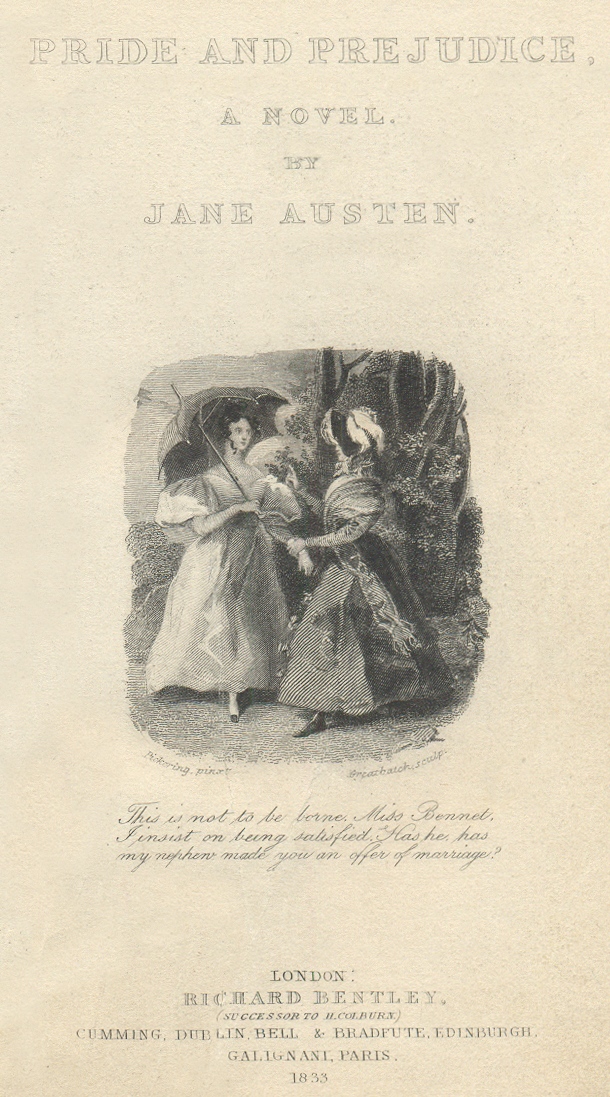
Title page of the
first illustrated edition
of "Pride and Prejudice"
Marriage runs rampant in Jane Austen's "Pride and Prejudice". It seems to be on every page of the book. There are marriage arrangements, marriage hopes, bad marriages, good marriages and engagements. Literally every character is involved in something that pertains to marriage. Mr. Bennet suffers through his marriage with amusement. Mrs. Bennet obsesses over getting her daughters married. The youngest Bennet daughters obsess about getting themselves married as much as their mother does and so on.

*Spoilers ahead

The eldest Bennet daughter, Jane, falls in love with Mr. Bingley in "Pride and Prejudice". He loves her back, but his friends and family believe an engagement to be a bad idea. Mrs. Bennet wants to see her eldest daughter married to the rich Mr. Bingley. Elizabeth and Mr. Bennet just want to see Jane happy. In the end, all turns out well for Jane and she marries Mr. Bingley. This is a good example of how much marriages of the time were influenced by opinion. It is also a good example of Ms. Austen's love for happy endings.

Elizabeth doesn't dwell on the idea of marriage much in the novel. However, she finds herself falling in love with a man that she believes she has good reason to despise. In classic Jane Austen style, Elizabeth marries this man, who happens to be rich, and lives happily ever after. This is the main plot line of the story and it played out so well that the novel has been popular for nearly 200 years.

Elizabeth was proposed to before she married Mr. Darcy by her cousin Mr. Collins. Elizabeth refused to marry her cousin. He went on to marry Elizabeth's best friend, which she strongly opposed. However, in the end, it was a happy match and Elizabeth grew to accept it.

Speaking of engagements and cousins, Elizabeth's husband was engaged to his cousin before he met Elizabeth. Of course, love prevailed (Thank you, Jane Austen.) and the engagement was broken. Nonetheless, this engagement gave readers a good example of how marriages among the aristocracy were handled at the time. Furthermore, it gave us a little intrigue and kept us guessing. . . kind of.

Elizabeth's youngest sister Lydia also gets married in "Pride and Prejudice". Her marriage is a shameful one. She ran off with a disgraced military officer and was only saved from disgrace herself when Mr. Darcy came to her rescue and forced the officer–Mr. Wickham–to marry her. This little twist leaves the reader loving Mr. Darcy, hating Mr. Wickham and shaking their head and Lydia. It also gives us a glimpse of how societal whims played a huge role in marriages of the time.


There are many other marriage issues that are alluded to in "Pride and Prejudice". There is an attempted engagement with Georgiana by Mr. Wickham for money.  Miss Bingley's wish to marry Mr. Darcy is alluded to. The ill-advised coupling of the elder Bennets is mentioned, as is the happy coupling of Elizabeth's aunt and uncle. There is even a small mention that Mary Bennet felt Mr. Collins may be a good match for her. Marriage is not just a theme in "Pride and Prejudice". It is the theme.

Friendships in "Pride and Prejudice" by Jane Austen

Jane Austen describes several friendships in "Pride and Prejudice," each of a different sort. Friendship is represented as fickle, deep and abiding and as allowing for love and respect, so long as the other is living by your standards. In other words, friendship in "Pride and Prejudice" is represented much as it is in real life.

One of the first friendships a reader comes across in "Pride and Prejudice" is that of Mrs. Bennet and Lady Lucas. The two women get together frequently to gossip. However, Mrs. Bennet seems much more inclined to petty gossip than Lady Lucas. Lady Lucas appears to be a much more levelheaded individual than Mrs. Bennet is, though Mrs. Bennet does frequently express suspicion that Lady Lucas is trying to one up her in some way or another. This is a sort of fickle and petty, yet constant friendship. All of the negative aspects of this friendship come from Mrs. Bennet's behavior, from the reader's perspective.

The next friendship to be mentioned in "Pride and Prejudice" is that of Elizabeth Bennet and Lady Lucas' daughter, Charlotte. The two young women are like-minded confidantes. However, their standing in life and their take on love and marriage is quite different. The friendship appears to be based on a degree of love and respect. Unfortunately, one of Elizabeth's only truly blameworthy actions in the novel is directed at Charlotte. She feels as if her friendship with Charlotte must be over when Charlotte marries a man of whom she disapproves. It is a shallow and selfish feeling and Elizabeth eventually overcomes it.

The third, and last, of the main friendships in "Pride and Prejudice" is the most influential of all of them. This is the friendship between Mr. Darcy and Mr. Bingley. The roots and reasons for their relationship are not discussed in Jane Austen's "Pride and Prejudice." However, the nature of their friendship is discussed on several occasions. These two men are of different, but complementary, temperaments. Mr. Darcy is proud, assertive, calculating and judgmental. Mr. Bingley is carefree, kind, giving and understanding. Mr. Darcy takes it upon himself to 'look out for' Mr. Bingley and winds up endangering Mr. Bingley's relationship. However, these issues are ironed out in the end and the pair's friendship does not suffer for it.


There are few other friendships mentioned in Jane Austen's "Pride and Prejudice." For the most part, everyone is 'friendly' with everyone else, but this seems to take place due to societal expectations of the day. There is no indication that Jane was attempting to present any of these passing 'friendships' as anything deeper than that. In fact, some were laced with underlying scorn or ignorance.

Shelly Barclay

Books I Have Read More Than Once

Harper Lee
Harper Lee
Some books are just so good that you have to read them again. Sometimes, you have to read them repeatedly. It does not matter how intellectual or significant the book is; there is just something about it that keeps drawing you back into the story. For me, this has been true for a great many books. However, there are a rare few that I have found myself reading closer to five times than one.

The Harry Potter series by J.K. Rowling


The Harry Potter series is not particularly mature reading. It is best described as youth fiction and easy to read youth fiction at that. This is certainly not typically the type of book I indulge in, let alone indulge in over and over. There is just something about these books that kept me coming back. I felt sorry for Harry; I loved the idea of witches and wizards living secretly amongst muggles; I was intrigued by the duality and complex nature of so many of the characters and, well, I was smitten with a group of books. I have read every single one of them about five times. I find myself reading them again every time a new Harry Potter movie comes out. Do not tell anybody, though. I am a little too old for Harry Potter.

"To Kill a Mockingbird" by Harper Lee


"To Kill a Mockingbird" is, in my opinion, the best American novel ever written. Many would argue that assertion, but my love of this novel is unwavering. This book tells the story of a town, torn apart by bigotry and false accusations. It brings to light the bravery of people who have the nerve to stand up for people who cannot stand up for themselves in a racist southern town. Furthermore, it shows us that this bravery can be found in the least likely of places. "To Kill a Mockingbird" is nothing short of brilliant. I have no idea how many times I have read it.

"The Lord of the Rings" by J.R.R. Tolkien


J.R.R. Tolkien may not be the most flamboyant of authors. In fact, his work is rather in-depth and dry. However, it is his precision and attention to detail that make his works so wonderful. "The Lord of the Rings" contains so much accurate (in as much as it can be) information about a fictional world that it can make a writer's head spin. Every time I read it, I wonder how on Middle Earth he could have been so accurate and detailed at the same time. Every writer knows it is hard to avoid mistakes when you go for such a broad scope as creating another world, full of different races and even languages. Mistakes were exceedingly rare in this (these) book (books).

Other books that I have read more than once include several Charles Dickens titles, "Pride and Prejudice" by Jane Austen, "The Stand" and "The Girl Who Loved Tom Gordon" by Stephen King and many more. I never find these books less enjoyable the more I read them. I hope that you have found some great books that make you feel the same way.

Three Influential Female Writers of the 19th Century

The nineteenth century was an interesting time for female authors. Many of the world’s greatest female authors were published during this time and the work they published would change the face of literature for more than just women. The publishing world had been truly opened up to them, even if many of them were still forced to publish under pseudonyms, for various reasons. Listed here are three of the best book-writing women of the time, in no particular order.
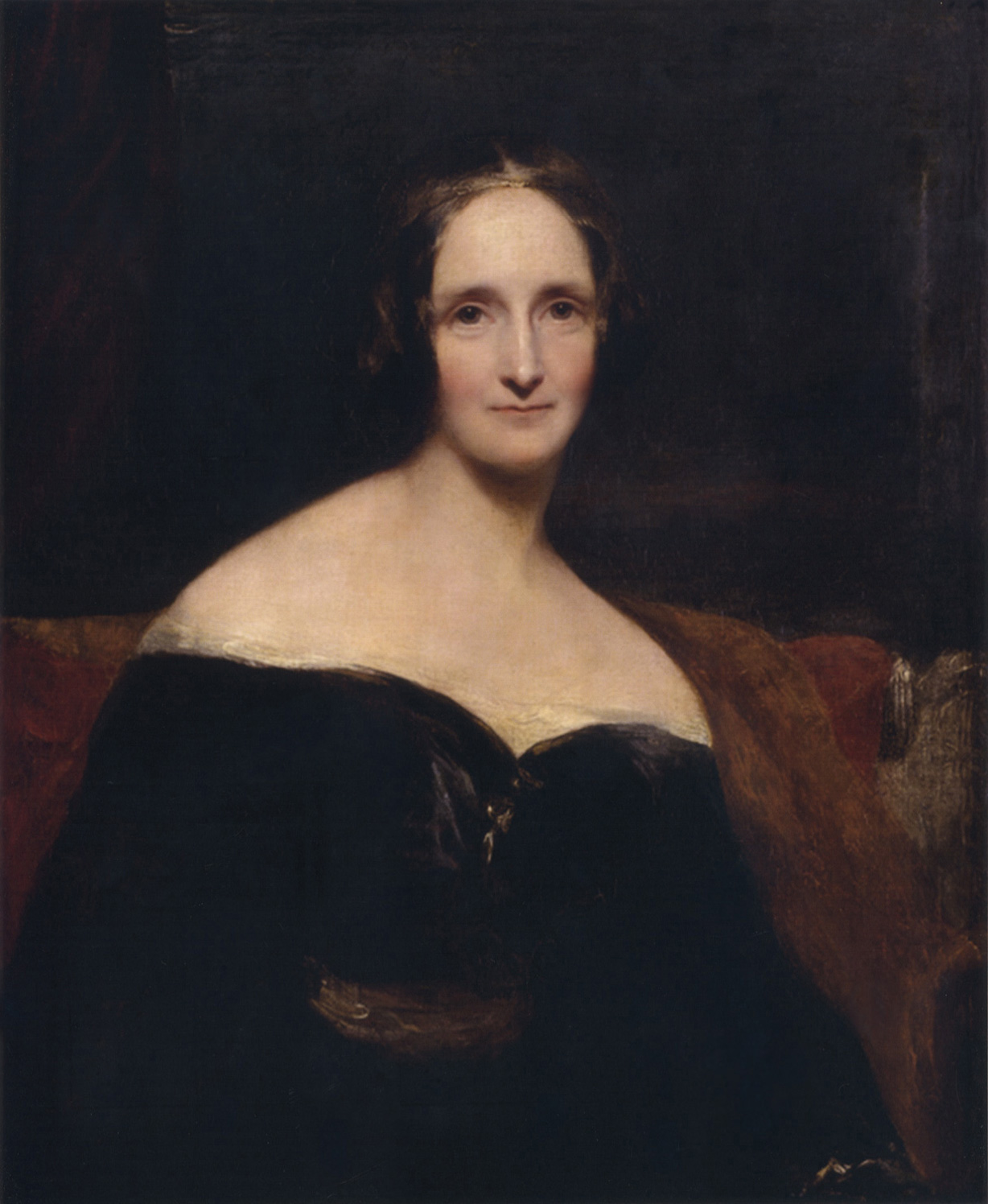
Mary Shelley
Mary Wollstonecraft Shelley

Mary Wollstonecraft Shelley was born on August 30, 1797. Her mother passed away eleven days after she was born. Her father eventually remarried and Mary grew up with her siblings, her father, her stepmother and her stepsiblings. She was mainly home schooled, but she was influenced greatly by her father and his intellectual friends, who were among some of the best thinkers of the time. Presumably under their tutelage, Mary published her first poem when she was only ten years old.

In 1814 at the age of sixteen, Mary ran away with the man who was the love of her life, Percy Bysshe Shelly. Percy was married at the time, but both of the lovers were impetuous and romantic. Mary went on to write a book about their impromptu trip together called "History of a Six Weeks Tour." She soon became pregnant with Percy’s child. She lost the child and two more, but the couple did go on to produce a son together.

In 1816 Percy’s wife committed suicide and then Mary and Percy married on December 30, of the same year. Two years later, in 1818, Mary Shelley published her greatest work, the timeless classic, "Frankenstein." In 1822 Percy Bysshe Shelley died in a drowning accident while going to visit with friends. After his death, Mary published several novels, but none were as popular as "Frankenstein." She died in her home in London on February 1, 1851.

Emily Dickinson
Emily Dickinson

Emily Dickinson was born on December 10, 1830 in Amherst, Massachusetts. Emily’s father was a lawyer and worked as the treasurer at Amherst College. He was also very active in politics. Emily was a bright young girl and by all accounts was witty, but shy. She had a normal childhood and traveled when necessary. She also attended Amherst College for a short time before having to drop out due to an illness.

Despite her normal upbringing and relatively active childhood, Emily slowly became a recluse after her time in college. She was rarely seen out of her house later in her life. However, she did manage to form and maintain close bonds with her friends through letters. Her works actually seem to have been improved by her self-imposed confinement. She was a prolific poet and her works spoke very authoritatively on matters such as love, death and suffering.

Emily lived in her parents' home up until her death. She never married or had children. In fact, it seems that she never had a romantic relationship at all. She died in 1886, at the age of eighty-six. It was only then that the true extent of Emily’s talent was revealed. During her life, she had only revealed a scant few of her poems to her closest friends and family. Upon her death, her sister discovered that Emily had written close to two thousand poems.

Jane Austen
Jane Austen

Jane Austen was born in England on December 16, 1775. She was one of eight children. At the age of eight, Jane went to a boarding school, where she received her formal education. However, most of her knowledge and inspiration for her work came from her family and her father’s library. Jane came from a very loving and close family that encouraged her writing and extensive reading very much. She would write poems, plays and stories that she would read to her family or enact with them.

In 1795 an event occurred that was likely the inspiration for many of Jane’s future novels. Jane Austen met Tom Lefroy. The pair fell in love with each other, but their union was frowned upon by Tom’s family, which was paying for his schooling and thought the match below him. They sent Tom away and the pair never saw each other again. Four years later, Jane published a novel that she called “First Impressions.” This masterpiece would later become known as "Pride and Prejudice." There are many similarities between this story and Jane’s life, but there is one major difference, the couple lives happily ever after.

Jane went on to publish a handful of novels in her lifetime, all of which met with success. They also shared a common theme, couples that married for love and not for money. Jane must have decided that she herself would never marry without love. She remained single for the rest of her life after losing Tom, and died at the age of forty-two at her home in Winchester, England.

Sources

Jane Austen Biography, retrieved 9/5/09, janeausten.org/jane-austen-biography.asp

Biography of Emily Dickinson, from Michael Myers, Thinking and Writing about Literature, 138-42, retrieved 9/5/09, vcu.edu/angweb/eng384/amilybio.htm

Mary Wollstonecraft Shelley, retrieved 9/5/09, english.upenn.edu/Projects/knarf/MShelley/bio.html